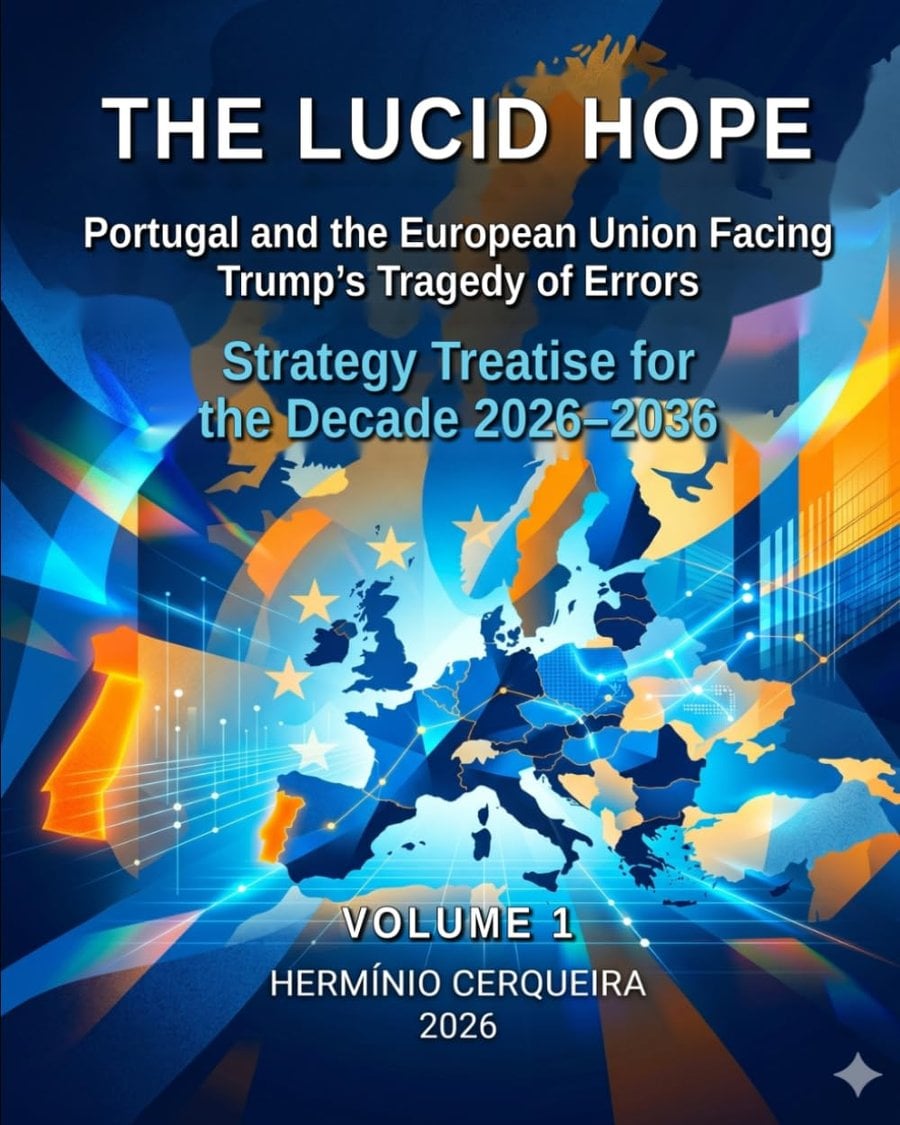
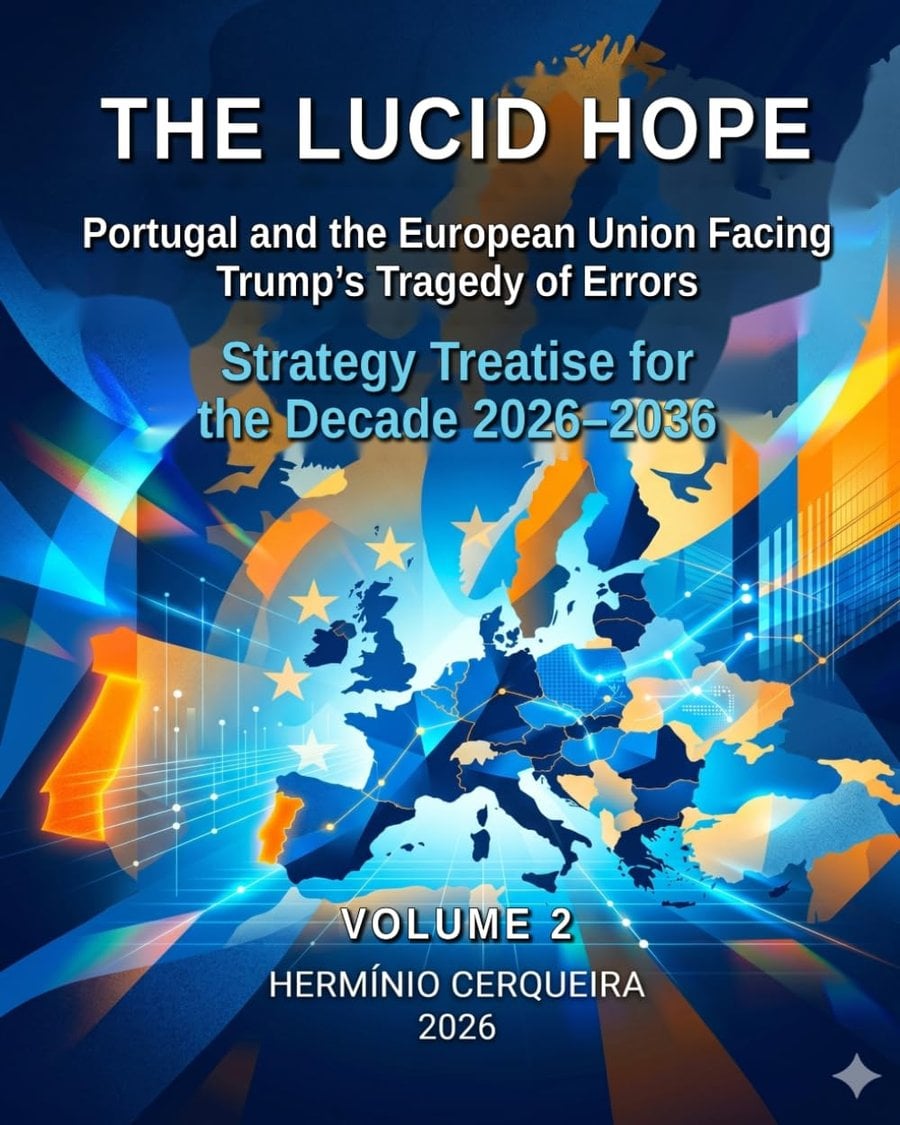
Europa, Portugal und politische ÖkonomieEssayBand 2
Lucid Hope, Band 2
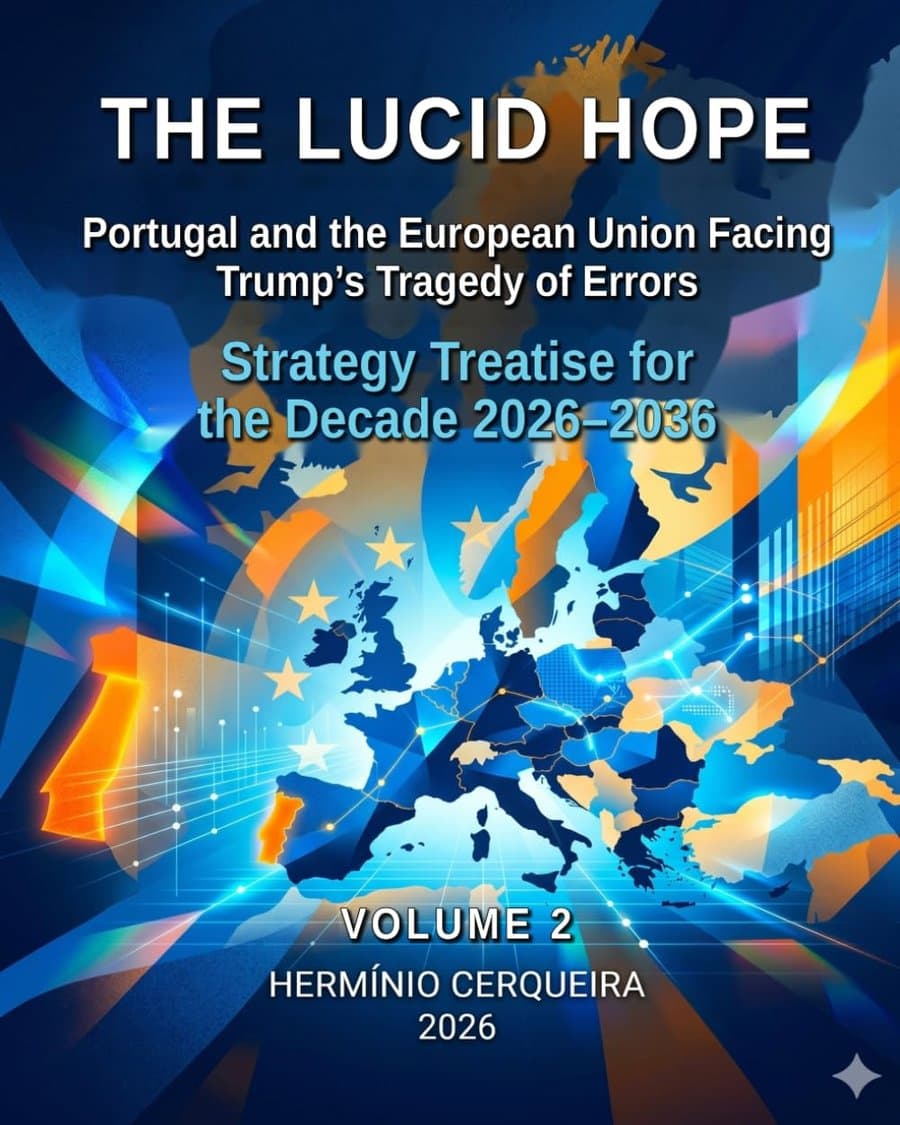
Portugal and the European Union in the Face of the Tragedy of Trump's Mistakes
„A esperança não é optimismo. É lucidez activa: a vontade de pensar e de agir como se a história voltasse a ser, em parte, nossa.“
- Seiten
- 391 Seiten
- ISBN
- ISBN 979-8195673000
- Erstveröffentlichung
- Formate
- Kindle und Taschenbuch
Leseprobe
Portugal and the European Union
in the Face of the Tragedy of Trump's Mistakes
Treaty on Political, Economic, Financial,
Trade, Social, and Military Strategy Treaty for the Decade 2026–2036
From Lucid Diagnosis to Operational Strategy — The Decade 2026–2036
Volume II of Lucid Hope takes up where Volume I closed. Volume I described the conditions; Volume II proposes a programme. The change of register is significant. A diagnosis can be careful and, in a sense, relatively safe: it describes what already exists and asks the reader to accept it.
— Lucid Hope — Band 2
Originaltext auf Englisch.
Redaktionelle Anmerkung
Quelle: Verlagsbeschreibung der Ausgabe auf Englisch (Amazon).
Über das Buch
Beschreibung aus der Originalausgabe, auf Englisch. Der Text schließt an die Leseprobe an.
A programme is not safe in the same way: it commits the author to choices, to sequences, to numbers, and to the specific institutional vehicles required to translate analysis into outcomes. The pages that follow assume that risk knowingly.
The volume is organised into two complementary movements. The first is documentary: it begins with the appendices and chronologies that belong to the broader diagnosis but were held back from Volume I to preserve the analytical line of argument there. These materials — the detailed chronology of 2018–2026, the bibliography organised by topic, and the biographical notes on the principal authors and figures cited — are not ornamental. They are the empirical scaffolding on which the strategic claims of both volumes rest, and the serious reader will return to them as the argument proceeds.
The second and longer movement (Parts XI through XIX) is operational. It opens with the full scenario set for Portugal and for the European Union — three Portuguese scenarios, three European Union scenarios, a four-cell cross-reference matrix, and an explicit treatment of external shocks, black swans and green swans. From there the argument proceeds to the Ten-Year Strategic Plan proper, organised in two parallel sequences: a five-chapter Portuguese plan covering economy, defence, energy and society, and a five-chapter European plan covering economy, defence, energy and democracy-with-enlargement.
The volume then enters the most operationally specific chapters in the entire work. Part XIV examines NATO’s reconfiguration as a 70/30 Atlantic–Pacific alliance, the German Sondervermögen as the conventional spine of European deterrence, the political and industrial significance of Steadfast Dart 2026 as the first major NATO exercise without United States participation, and the collapse of the FCAS combat-aircraft programme as the catalyst for a reorganisation of the European military-industrial base. Part XV does the equivalent work for the energy file: REPowerEU 2.0, the SMR programme, the strategic role of the Charles de Gaulle in the Strait of Hormuz, the Anti-Coercion Instrument as a new lever of European retaliation, and the AccelerateEU 2026 integrated package.
Part XVI lifts the analysis to the global level: Taiwan, the China–Russia coordination of 2025–2026, NATO’s IPP4 expansion in Asia, the Arctic as a new operational front, and Turkey’s balancing act under the Montreux Convention. Part XVII brings the argument back to Portugal and asks what NATO 3.0 and REPowerEU 2.0 mean specifically for the Lajes airbase in the Azores, for the €40-million transport package of 2026, for the Portuguese defence industry, and for the Leixões and Sines port complexes. Part XVIII returns to comparative case studies — the British–American hegemonic transition revisited and the lessons of Korea, Singapore, Estonia, Ireland and Finland — to test the proposed Portuguese strategy against the empirical record of comparable transitions...
Verzeichnis der Ausgaben
Eine Zeile pro Ausgabe, in der Sprache, in der sie erschienen ist. Den Amazon-Shop wählen Sie einmal aus; er gilt für alle Ausgaben.
Ausgabe auf Englisch:
Lucid Hope
391 SeitenKindle und Taschenbuch
- In den Amazon-Shops verwendet jeder Link den eigenen Code der jeweiligen Ausgabe (ASIN); die Verfügbarkeit in den einzelnen Ländern regelt Amazon.
Kritische Lektüre – „A Obra Comentada“ (2026)
Eine kritische Lektüre in der dritten Person, übernommen aus „A Obra Comentada“, dem vom Autor selbst veröffentlichten kommentierten Werkverzeichnis. Es handelt sich nicht um eine Pressekritik.
Originaltext auf Portugiesisch.
Publicado em inglês em dois volumes sob o título Lucid Hope e em português num único e monumental tomo — A Esperança Lúcida, edição definitiva de Abril de 2026, com 25 partes, 150 capítulos, 8 anexos e 886 páginas —, este é o tratado do catálogo: um «Tratado de Estratégia Político-Económica, Financeira, Comercial, Social e Militar para a Década 2026–2036», apoiado numa compilação de 2.547 fontes documentadas. O título presta tributo expresso a Joseph Stiglitz, que cunhou a fórmula da «tragédia de erros» para a sequência desencadeada pelo regresso de Trump ao poder: a guerra de tarifas universal, a guerra cinética contra o Irão, o bloqueio do Estreito de Ormuz, o abandono da garantia americana à Europa — hybris no sentido aristotélico, não maldade pura, mas excesso de confiança do poder que ignora as consequências sistémicas dos seus actos.
A tese central está no próprio título e é formulada como décima tese da sinopse executiva: «A esperança não é optimismo. É lucidez activa: a vontade de pensar e de agir como se a história voltasse a ser, em parte, nossa.» Entre o catastrofismo e a ingenuidade, o tratado argumenta que o duplo choque de 2025-2026 colocou Portugal e a União perante uma bifurcação histórica — aprofundar a integração e construir autonomia estratégica real, ou fragmentar-se perante a nova desordem global — e que Portugal, pela sua geografia atlântica, infra-estrutura energética emergente e capital lusófono, está objectivamente melhor posicionado do que a maioria dos Estados-membros para ser protagonista, e não apenas receptor, da nova ordem europeia.
A estrutura é a de um verdadeiro tratado clássico: diagnóstico do colapso da Pax Americana (com uma notável leitura schmittiana do decisionismo presidencial americano, temperada pelo reconhecimento explícito dos limites morais de Schmitt), economia política da desordem global (o nexo gás-fertilizantes-alimentos transmitido pelo choque de Ormuz), a União em encruzilhada (legado Draghi, eurobonds, NATO 3.0), anatomia dos parceiros europeus, Portugal em profundidade (Sines «como projecto civilizacional», Açores, hidrogénio verde, CPLP), modelos políticos comparados e, por fim, o Plano Estratégico Decenal 2026–2036, com cenários quantificados — «Renascimento Atlântico», «Declínio Gerido» (a que atribui 55% de probabilidade) e «Ruptura e Recessão». Cada parte abre com uma vinheta ensaística e fecha com proposições accionáveis; a advertência metodológica assume três registos simultâneos — analítico-académico, propositivo-estratégico e ensaístico-literário — porque «as estratégias que não conseguem ser narradas não conseguem ser seguidas».
O diálogo intelectual é vastíssimo: Madison e Schmitt sobre os contrapesos e a excepção, Weber e o «cesarismo plebiscitário», Hassner e a aliança sem ilusões, Aron («a estratégia é o pensamento posto em acção»), Kindleberger, Gilpin, Arrighi e Tooze na literatura da transição hegemónica, Monnet e Draghi nas epígrafes. Mas o tratado termina em registo epistolar e quase lírico: duas cartas — a um jovem cidadão português e a um jovem cidadão europeu — que condensam o programa cívico do livro («Vai, e faz») e recusam tanto o «silêncio cínico» como a «indignação sem trabalho». No conjunto da obra, é a síntese maior do eixo: o livro onde o diagnóstico trumpiano do Eixo 4, a doutrina da autonomia estratégica e a crítica orçamental convergem num único programa para a década. A era que se abre é, escreve o autor, a do «regresso da soberania como verbo. Quem não conjugar este verbo, será conjugado por outros.»
Zitate aus dem Buch
„Tratado de Estratégia Político-Económica, Financeira, Comercial, Social e Militar para a Década 2026–2036“
„as estratégias que não conseguem ser narradas não conseguem ser seguidas“
„a estratégia é o pensamento posto em acção“
„regresso da soberania como verbo. Quem não conjugar este verbo, será conjugado por outros.“
Weitere zitierte Wendungen aus dem Buch
„tragédia de erros“„como projecto civilizacional“„Renascimento Atlântico“„Declínio Gerido“„Ruptura e Recessão“„cesarismo plebiscitário“„Vai, e faz“„silêncio cínico“„indignação sem trabalho“
Quelle: «A Obra Comentada» (Sintra, Julho de 2026) — comentário crítico
Bibliografische Angaben
- Gattung
- Essay
- Achse des Werks
- Europa, Portugal und politische Ökonomie
- Erstveröffentlichung
- Seiten
- 391 (Ausgabe auf Englisch)
- Formate
- Kindle-E-Book · Taschenbuch
- Sprachen
- 1 — Englisch
- ISBN
- 979-8195673000