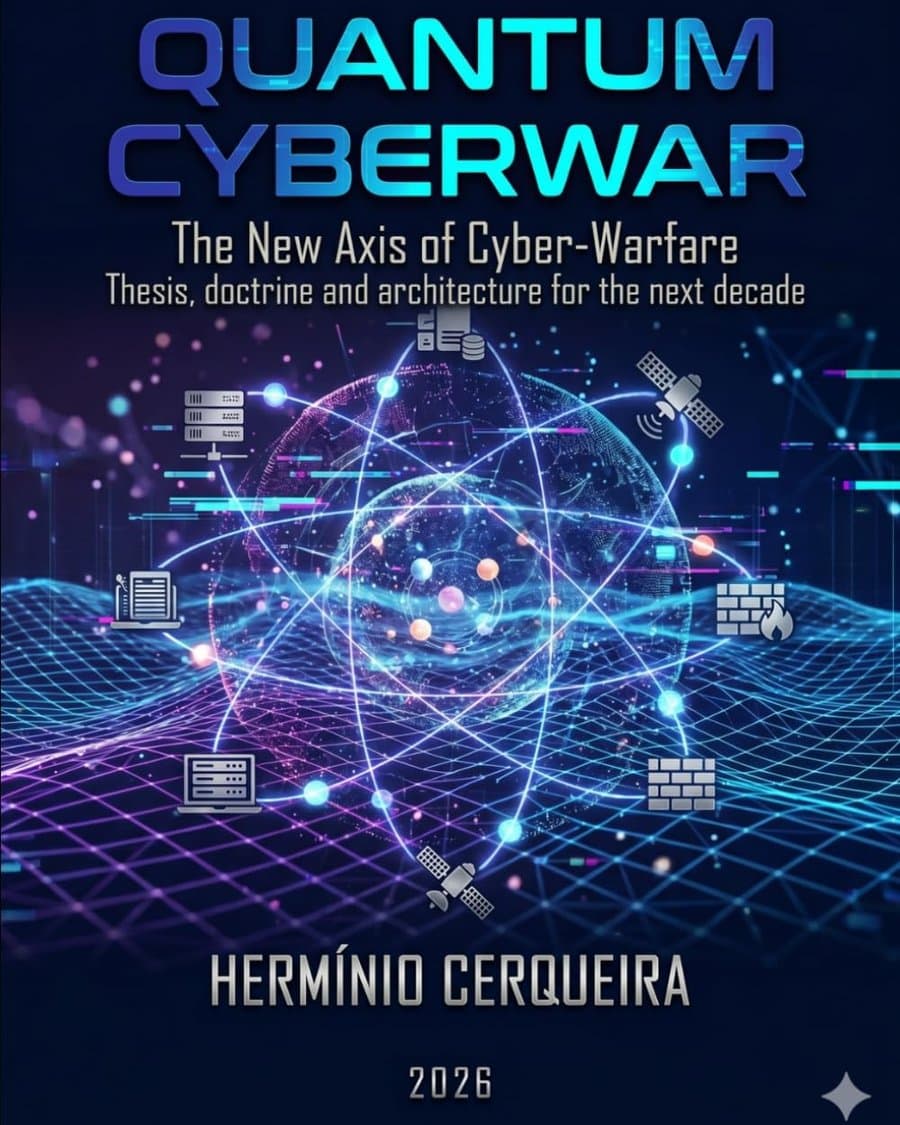
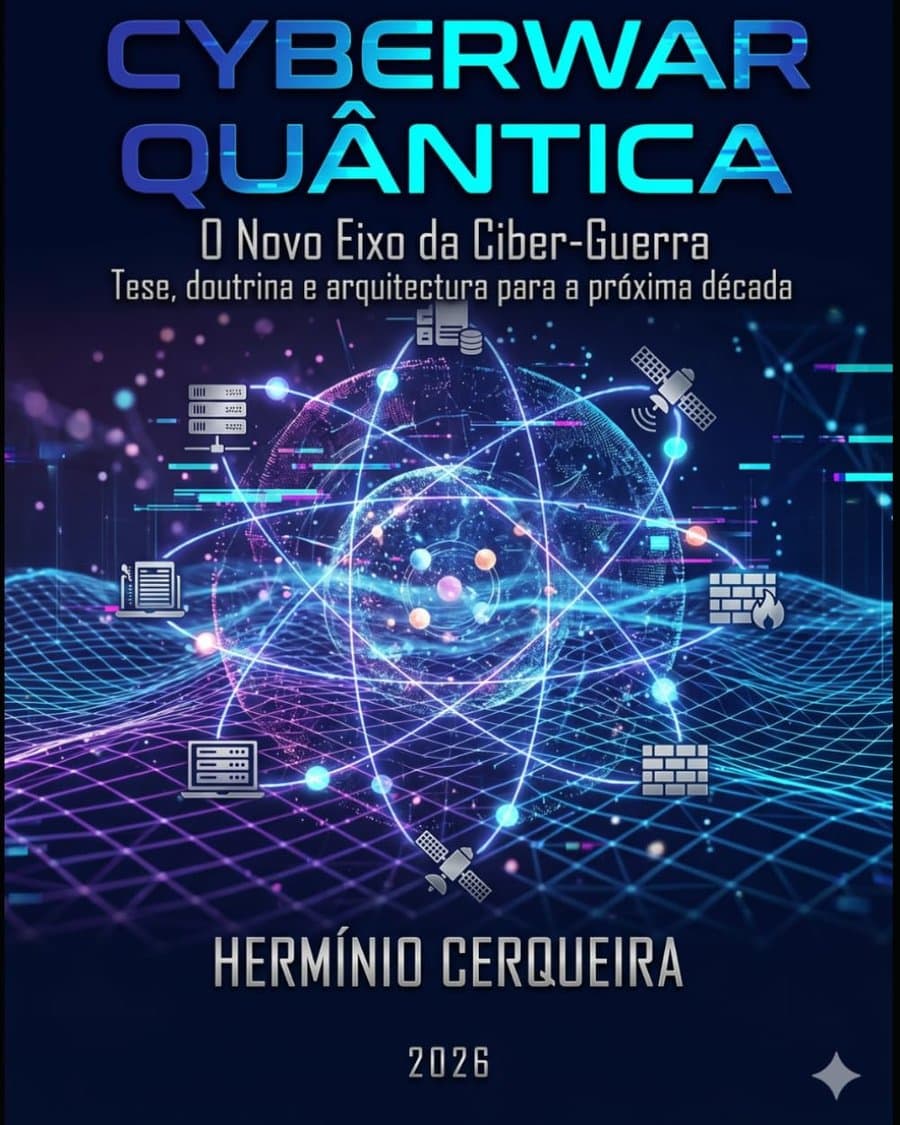
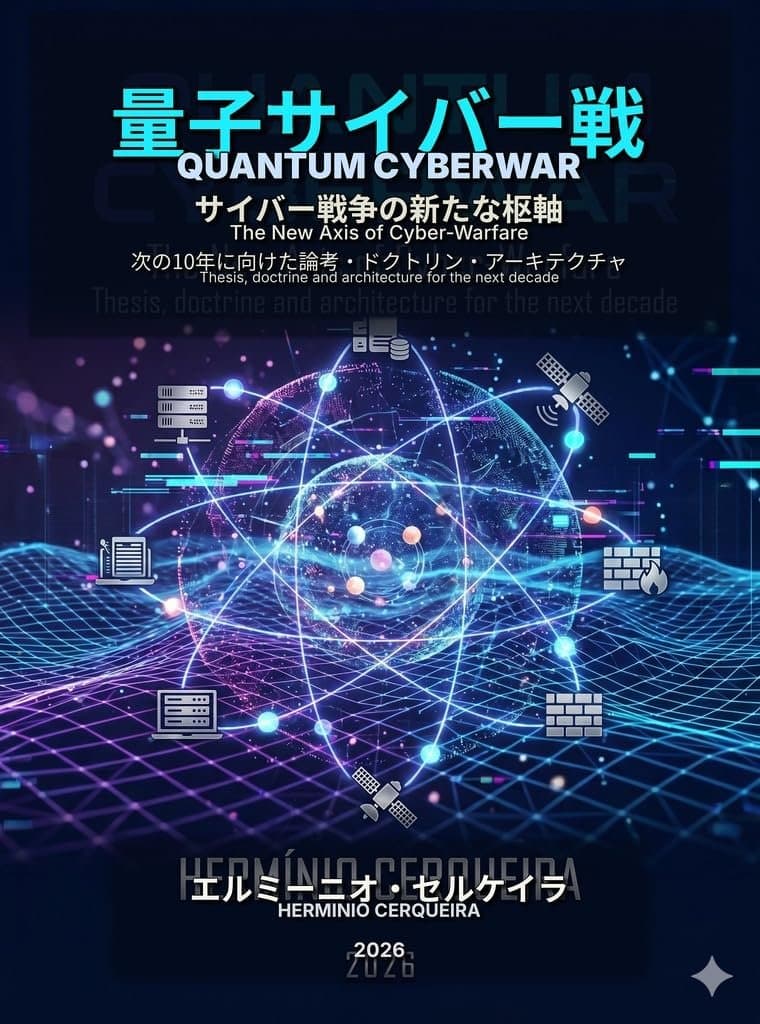
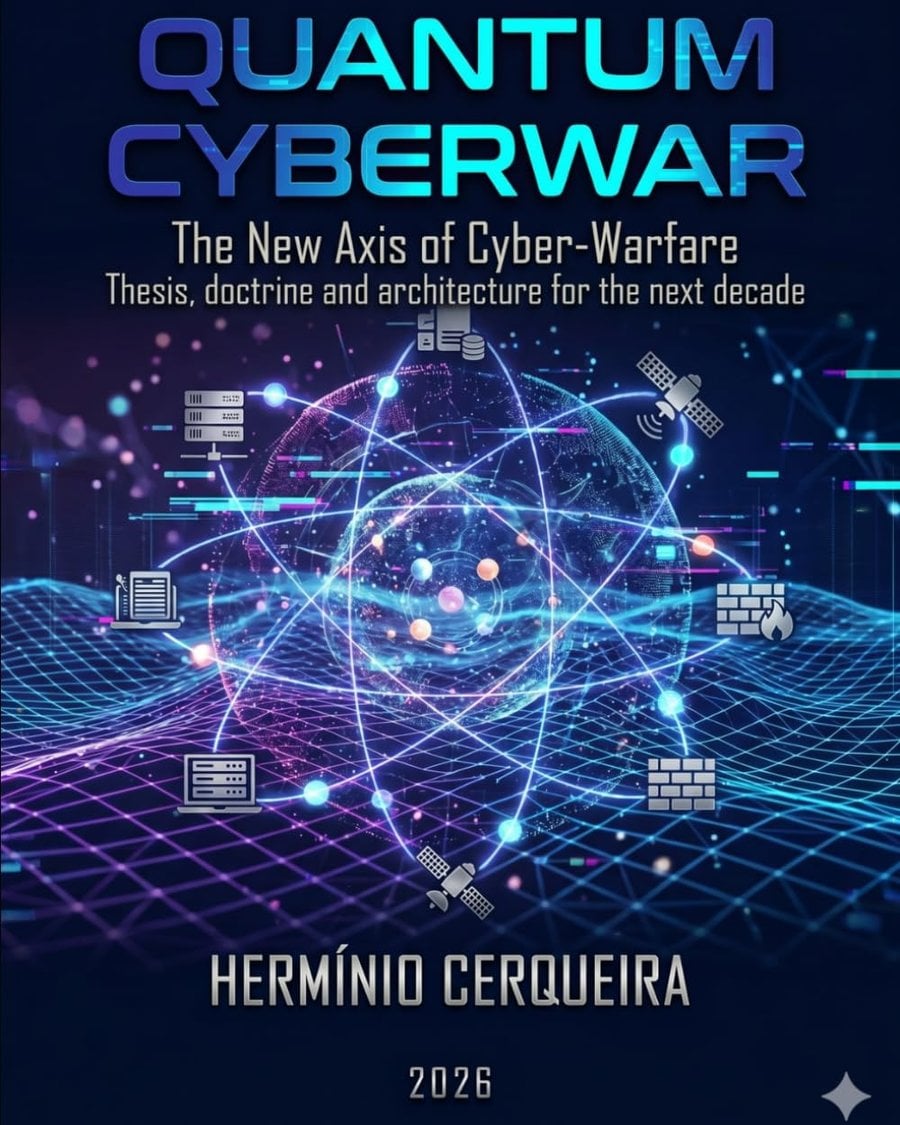
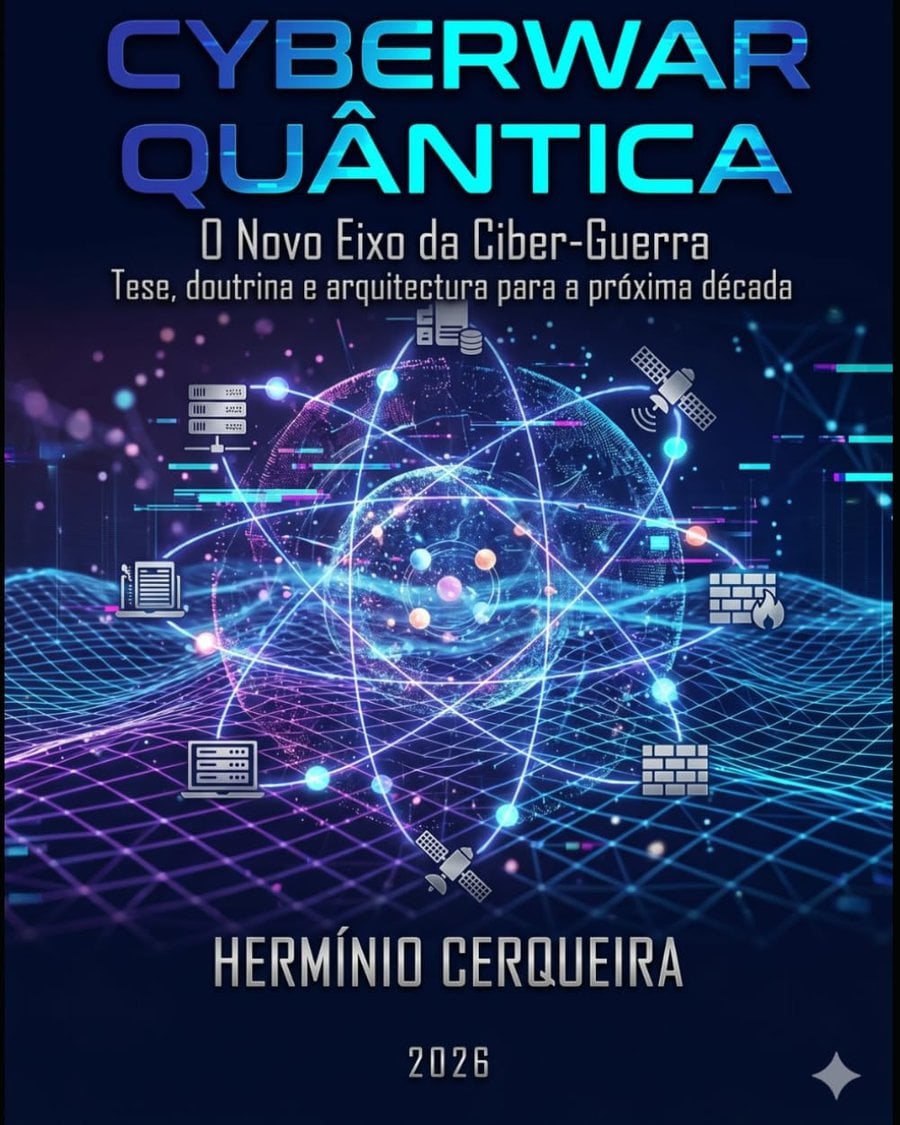
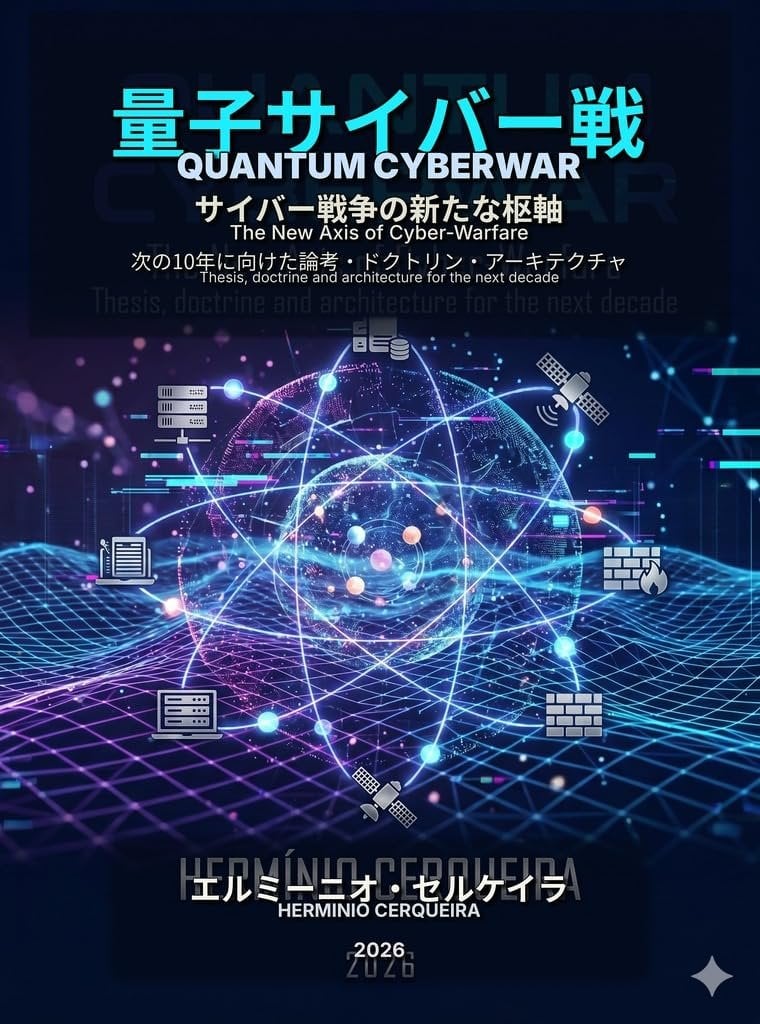
Quantum CyberwarCyberwar Quântica量子サイバー戦争
The New Axis of Cyber Warfare
O Novo Eixo da Ciber-Guerra
サイバー戦争の新たな軸 (Ryoshi Saiba Senso)
Available in 3 languages
“Portugal pode ser pequeno em dimensão e relevante em capacidade.”
- Pages
- 664 pages
- ISBN
- ISBN 979-8197405807
- Published
- Formats
- Kindle and paperback
- Pages
- 680 pages
- ISBN
- ISBN 979-8197379009
- First published
- Formats
- Kindle and paperback
- Pages
- 662 pages
- Published
- Formats
- Kindle
About the book
Text published with the English edition (Amazon).
This book stems from a conviction that has become progressively clearer over the last five years: cyber warfare is about to undergo the most profound transformation in its short history, and that transformation has a name—quantum computing. The reader who holds this work in their hands finds themselves, perhaps unknowingly, at a unique historical moment. Behind the apparent continuity of cybersecurity —the same protocols, the same certifications, the same vocabularies—a revolution is silently developing that will rewrite, within less than a decade, the fundamental rules of digital conflict.
The central thesis defended here is simple in its formulation but radical in its implications: quantum cyberwar is not just another technological vector to join those already existing— ransomware , phishing , exploits , disinformation. It is the new axis around which all modern cyber warfare is reorganized. Where the 20th century articulated power around the atom and space, and where the first decades of the 21st century articulated power around the bit and the network, the next decade will articulate power around the qubit—and who controls it, who fears it, who prepares for its arrival.
The writing of this book was guided by three principles. First, scientific and technical rigor. Every technical statement is based on accessible specialized literature; every reference has been verified; every algorithm discussed has been understood in its mathematical structure and operational implications. Second, clarity of strategic thinking. The work is primarily aimed at senior officers, policymakers, executives of critical organizations, and academic researchers—readers whose role demands multi-dimensional understanding , not just isolated technical knowledge. Third, pre-agreement European Portuguese, with deliberate literary care, avoiding untranslated Anglicisms whenever a precise Portuguese alternative exists.
Throughout these pages, the reader will find a well-argued and, I hope, persuasive defense of the central thesis. They will also find a comparative analysis of state capabilities—the United States, the European Union, China, Russia, and emerging powers—a technical description of the relevant quantum algorithms, a detailed examination of post-quantum alternatives under construction, and, finally, a reflection on the place of Portugal and Europe in this new power architecture.
The work is organized into five parts. Part I establishes the foundations—what cyberspace is as a domain of conflict, what classical cryptography is that protects our communications today, what quantum computing is as an emerging technology, and what is the specific nature of the threat that the latter represents to the former. Part II develops the offensive thesis— quantum cyberwar as a new axis of attack. Part III develops the defensive thesis— quantum cybersecurity as an institutional and technical response. Part IV offers a comparative analysis matrix between the two dimensions. Part V projects the desired evolution until 2040, with particular attention to the Portuguese case and the European architecture.
I hope the reader finds in this work a useful tool for their strategic thinking. If this book contributes, in a modest way, to accelerating Portuguese institutional maturation in the face of the impending quantum transition, it will have fulfilled its purpose. Any remaining errors, whether technical or interpretative, are the sole responsibility of the author.
Sintra Spring 2026
Hermínio Cerqueira
Excerpt
Este livro nasce de uma convicção que se tornou progressivamente mais clara ao longo dos últimos cinco anos: a guerra cibernética está prestes a sofrer a mais profunda transformação da sua história curta, e essa transformação tem nome — computação quântica. O leitor que tenha em mãos esta obra encontra-se, talvez sem saber, num momento histórico singular. Por trás da aparente continuidade da ciber-segurança — os mesmos protocolos, as mesmas certificações, os mesmos vocabulários — desenvolve-se silenciosamente uma revolução que reescreverá, dentro de menos de uma década, as regras fundamentais do conflito digital.
— Cyberwar Quântica
Original text in Portuguese.
Editorial note
Source: publisher’s description of the Portuguese edition (Amazon).
Index of editions
One line per edition, in the language in which it was published. Choose your Amazon store once; it applies to every edition.
English edition:
Quantum Cyberwar
664 pagesKindle and paperback
Portuguese edition:
Cyberwar Quântica
680 pagesKindle and paperback
Japanese edition:
量子サイバー戦争
662 pagesKindle
- In the Amazon stores, each link uses the edition’s own code (ASIN); availability in each country is managed by Amazon.
- In Portugal, buy from Amazon Spain: there is no Portuguese Amazon store.
Critical reading — “A Obra Comentada” (2026)
A third-person critical reading, reproduced from “A Obra Comentada,” the annotated catalog of the work published by the author himself. It is not a press review.
Original text in Portuguese.
Se o Manual é o "como", Cyberwar Quântica é o "porquê". A tese, formulada no prefácio com clareza programática, é «simples na sua formulação mas radical nas suas implicações»: a cyberwar quântica «não é apenas mais um vector tecnológico a juntar-se aos já existentes — ransomware, phishing, exploits, desinformação. É o novo eixo em torno do qual toda a ciber-guerra moderna se reorganiza». Onde o século XX articulou poder em torno do átomo e do espaço, e as primeiras décadas do XXI em torno do bit e da rede, a próxima década articulá-lo-á em torno do qubit — de quem o controla, de quem o teme, de quem se prepara para a sua chegada.
A obra organiza-se em cinco partes: fundamentos (o ciberespaço como domínio, a criptografia clássica, a computação quântica e a natureza específica da ameaça), a tese ofensiva (a cyberwar quântica como novo eixo de ataque), a tese defensiva (a cibersegurança quântica como resposta institucional), uma matriz comparativa entre as duas dimensões e a projecção até 2040 com atenção particular ao caso português. O prefácio declara três princípios de escrita — rigor científico verificado, clareza de pensamento estratégico para oficiais superiores e decisores, e português europeu pré-acordo com «cuidado literário deliberado» — e a introdução cumpre-os com uma das melhores explicações em língua portuguesa do que é, e do que não é, um computador quântico, desfazendo o equívoco da "computação mais rápida".
O método é comparativo e geopolítico: capacidades dos Estados Unidos (National Quantum Initiative, integração Five Eyes), da China (Military-Civil Fusion, laboratório de Hefei), da União Europeia (Quantum Flagship, EuroQCI), do Reino Unido, da Rússia pós-2022 e das potências médias (Japão com o Q-LEAP, Coreia do Sul, Israel). A análise económica é original e prudente: a capacidade CRQC ficará confinada, no horizonte de 2040, a um punhado de actores estatais ou consórcios, o que reorganiza a dissuasão sem a democratizar. A bibliografia final, com nota metodológica explícita, privilegia fontes primárias (NIST, CISA/NSA/FBI, ENISA, EUR-Lex, CCDCOE) e exclui deliberadamente «blogues comerciais não auditáveis» — declaração rara e saudável no género. O capítulo final sobre Portugal condensa a mensagem política do livro numa frase que é já divisa: «Portugal pode ser pequeno em dimensão e relevante em capacidade.»
No lugar da obra completa, este é o livro-tese do Eixo 2, charneira entre a geopolítica da Guerra Cibernética e a engenharia do Manual. É também, segundo o catálogo do autor, o título do eixo com projecção internacional mais singular — a edição japonesa anunciada sob o título Ryōshi Saibā Sensō —, escolha de mercado coerente com o peso que o próprio texto dá ao ecossistema quântico japonês, da Toshiba à Tokyo QKD Network. A sua força está na unidade de argumento; a sua fragilidade, assumida pelo autor, é a datação rápida de qualquer análise comparativa de capacidades. Fica o essencial: a demonstração de que o eixo do conflito digital se deslocou, e de que quem não se preparar «encontra-se, talvez sem saber, num momento histórico singular».
Quotations from the book
“não é apenas mais um vector tecnológico a juntar-se aos já existentes — ransomware, phishing, exploits, desinformação. É o novo eixo em torno do qual toda a ciber-guerra moderna se reorganiza”
“simples na sua formulação mas radical nas suas implicações”
“encontra-se, talvez sem saber, num momento histórico singular”
Other expressions quoted from the book
“cuidado literário deliberado”“blogues comerciais não auditáveis”
Source: «A Obra Comentada» (Sintra, Julho de 2026) — comentário crítico
Book details
- Genre
- Essay
- Axis of the work
- Cyber Defense and the Quantum Era
- First published
- Pages
- 664 (English edition)
- Formats
- Kindle e-book · Paperback
- Languages
- 3 — Portuguese, English, and Japanese
- ISBN
- 979-8197405807