


Artificial IntelligenceManuals and technique
GeopolSimGeopolSim
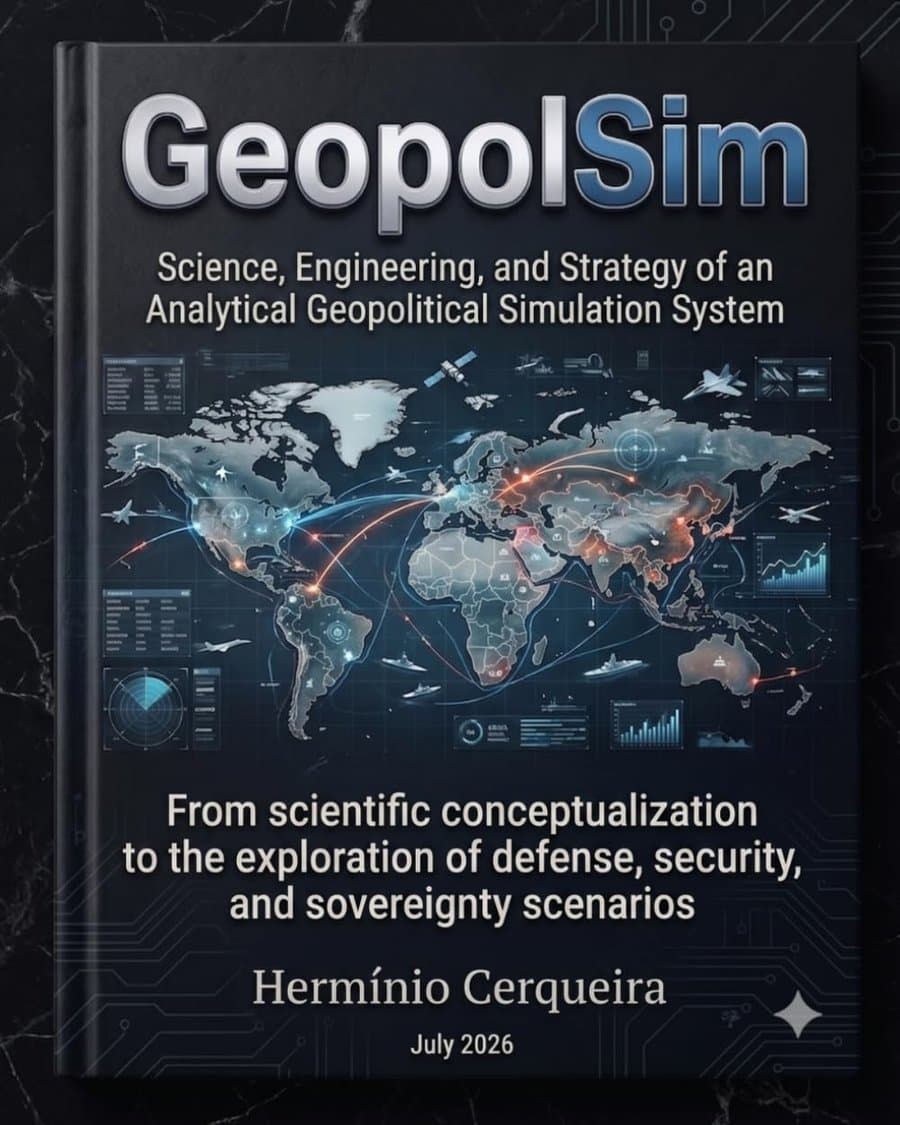
Science, Engineering and Strategy of a System Geopolitical Simulation Analytics
Ciência, Engenharia e Estratégia de um Sistema Analítico de Simulação Geopolítica
Available in 2 languages
- Pages
- 815 pages
- ISBN
- ISBN 979-8187470198
- Published
- Formats
- Kindle and paperback
- Pages
- 828 pages
- ISBN
- ISBN 979-8187430444
- First published
- Formats
- Kindle and paperback
About the book
Text published with the English edition (Amazon).
Science, Engineering and Strategy of a System - Geopolitical Simulation Analytics
From scientific conception to the exploration of defense scenarios, security and sovereignty
This work stems from a concrete project and a conviction. The project is GeopolSim, a software system for analytical simulation of geopolitical dynamics, conceived, designed, and built as a tool to support strategic reasoning. The conviction is that defense and security issues—precisely because they are serious, uncertain, and often irreversible—demand more rigor, not less; more transparency, not more mystery; more epistemic humility, not more false certainties.
I write in the first person only in this note. The rest of the work adopts the impersonal voice and register proper to a technical and scientific work, because that is the appropriate form for its purpose: to serve as a reference for those who design, decide, teach, and research. To this end, I have gathered the perspectives of an imagined, but methodologically disciplined, multidisciplinary team—that of the scientific researcher, the systems engineer, the military strategist, the defense analyst, the geopolitics specialist, the military historian, the defense economist, the logistics specialist, the jurist, the risk manager, and the editor. Each chapter seeks to honor these perspectives without succumbing to the temptation of diluting them into a vague common denominator.
I owe the reader two warnings. The first is that GeopolSim does not predict the future, nor was it designed to do so; it describes hypothetical states and their coherence, and it is in this restraint that its usefulness lies. The second is that, whenever data is insufficient, the uncertainty is stated and conjectures are identified as such. No data, organization, experiment, or result was invented to fill gaps. Where proof is lacking, it is written that it is lacking.
There is a third point that seems fair to explain, precisely because it is the least obvious. The decision to write a book about a software system—and not just to document the software—is based on a fundamental reason: an instrument that aims to support reasoning about power, conflict, and deterrence cannot be evaluated solely by what it does, but also by what it assumes, what it excludes, and what it declares it does not know. Code executes; a book accounts for what it does. What is sought here is that the system be understandable not only in its functions, but also in its boundaries, and that these boundaries be a matter of open discussion, not convenient silence.
I also confess to a reservation that permeated the entire work and which I preferred to keep rather than conceal. The ease with which a seemingly technical instrument acquires authority—the almost automatic effect by which a number on a screen appears more truthful than the judgment that produced it—is, in my view, one of the most serious risks of this kind of tool. I wrote a good part of this work thinking about this risk and against it. Hence the insistence, which the reader will certainly notice and perhaps find excessive, on repeating that the indices are relative, that the results are conditioned by assumptions, and that the decision remains, entirely and non-delegable, on the human side.
Finally, a word about what this work deliberately is not. It is not a defense of the system against hypothetical critics, nor a sales pitch aimed at hypothetical buyers. It is an attempt to expose, with the greatest honesty I could muster, what GeopolSim is, what it legitimately allows you to do, and what, by nature or by state of maturity, it does not yet allow. If the reader finishes the book more aware of its limitations than of its promises, I will have fulfilled the essential purpose of what I set out to do, because it is from this awareness—and not from enthusiasm—that the responsible use of any defense decision-support tool is born...
Excerpt
Ciência, Engenharia e Estratégia de um Sistema - Analítico de Simulação Geopolítica
Da concepção científica à exploração de cenários de defesa, segurança e soberania
Esta obra nasce de um projeto concreto e de uma convicção. O projeto é o GeopolSim, um sistema de software para simulação analítica de dinâmicas geopolíticas, concebido, desenhado e construído como instrumento de apoio ao raciocínio estratégico. A convicção é a de que as questões de defesa e segurança — precisamente por serem graves, incertas e frequentemente irreversíveis — exigem mais rigor, e não menos; mais transparência, e não mais mistério; mais humildade epistémica, e não mais falsas certezas.
— GeopolSim
Original text in Portuguese.
Editorial note
Source: publisher’s description of the Portuguese edition (Amazon).
Index of editions
One line per edition, in the language in which it was published. Choose your Amazon store once; it applies to every edition.
English edition:
GeopolSim
815 pagesKindle and paperback
Portuguese edition:
GeopolSim
828 pagesKindle and paperback
- In the Amazon stores, each link uses the edition’s own code (ASIN); availability in each country is managed by Amazon.
- In Portugal, buy from Amazon Spain: there is no Portuguese Amazon store.
Book details
- Genre
- Manuals and technique
- Axis of the work
- Artificial Intelligence
- First published
- Pages
- 815 (English edition)
- Formats
- Kindle e-book · Paperback
- Languages
- 2 — Portuguese and English
- ISBN
- 979-8187470198