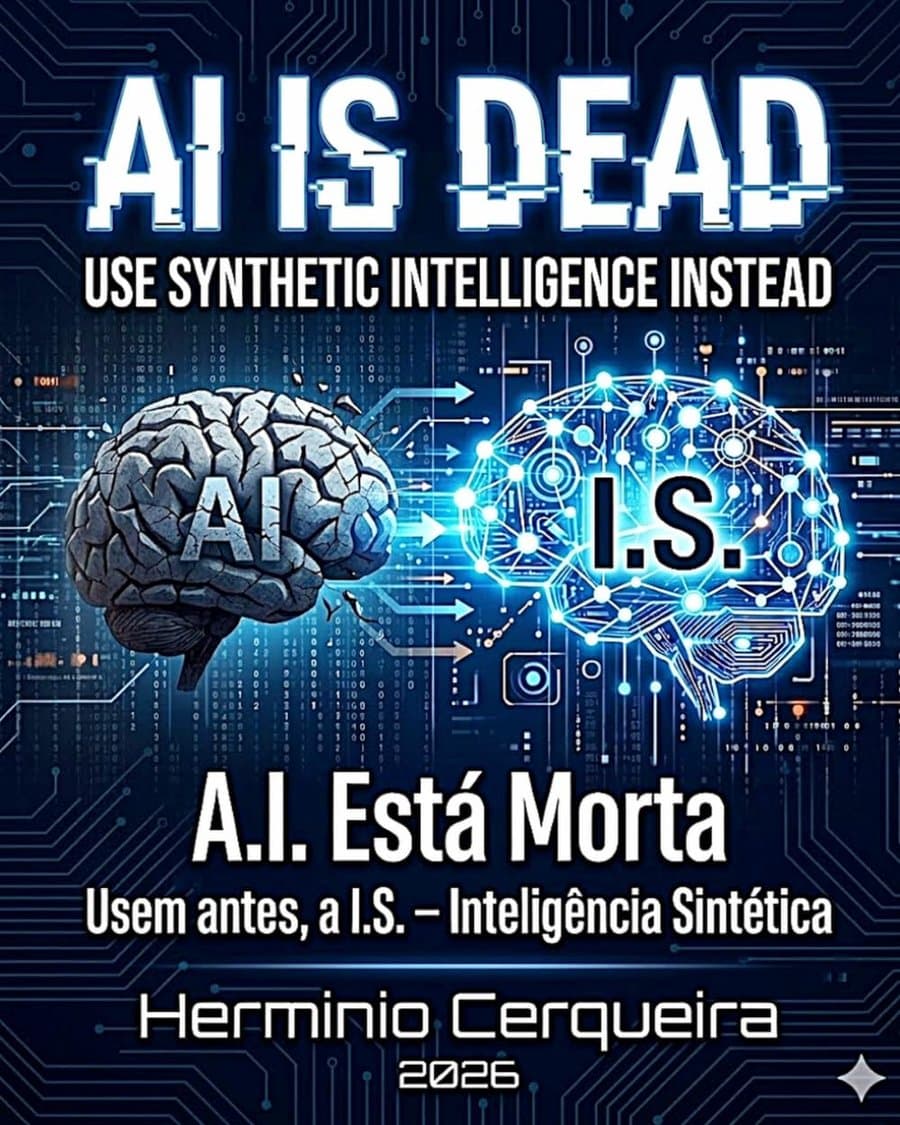
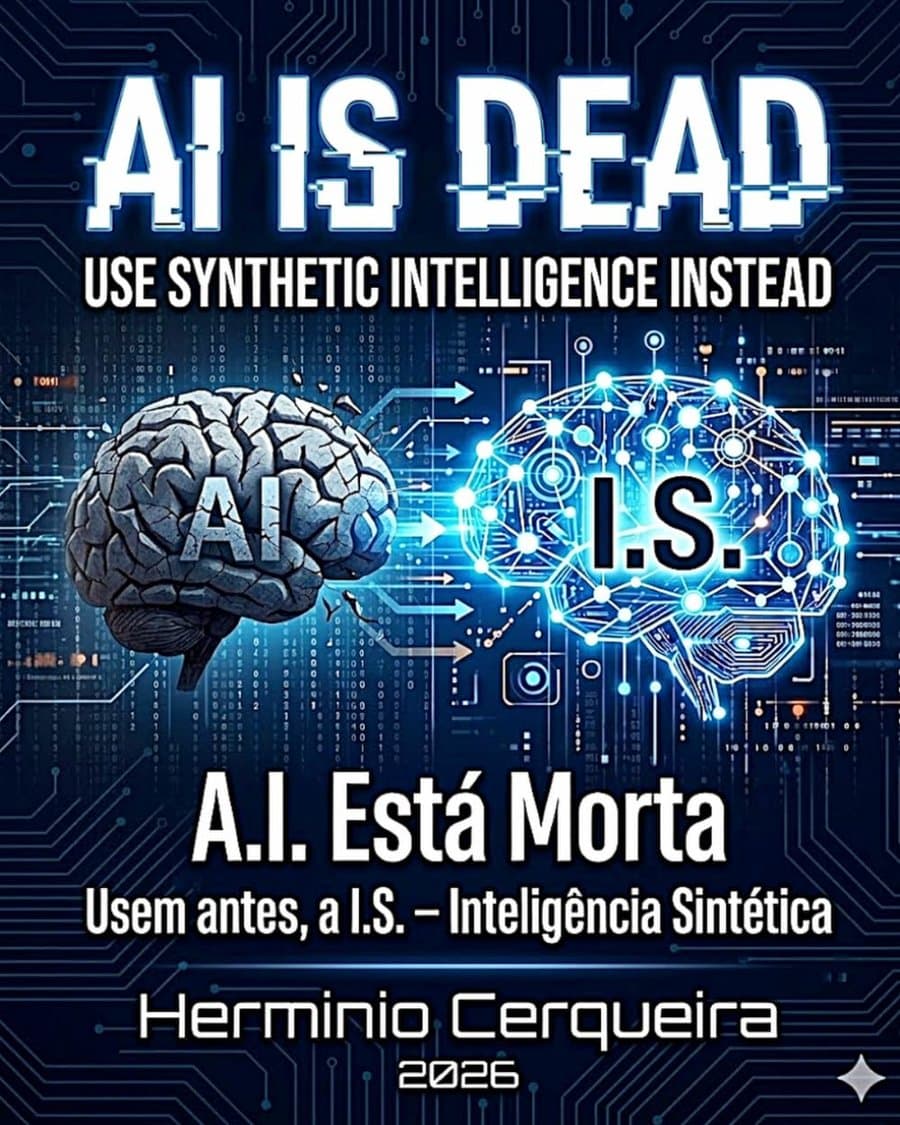
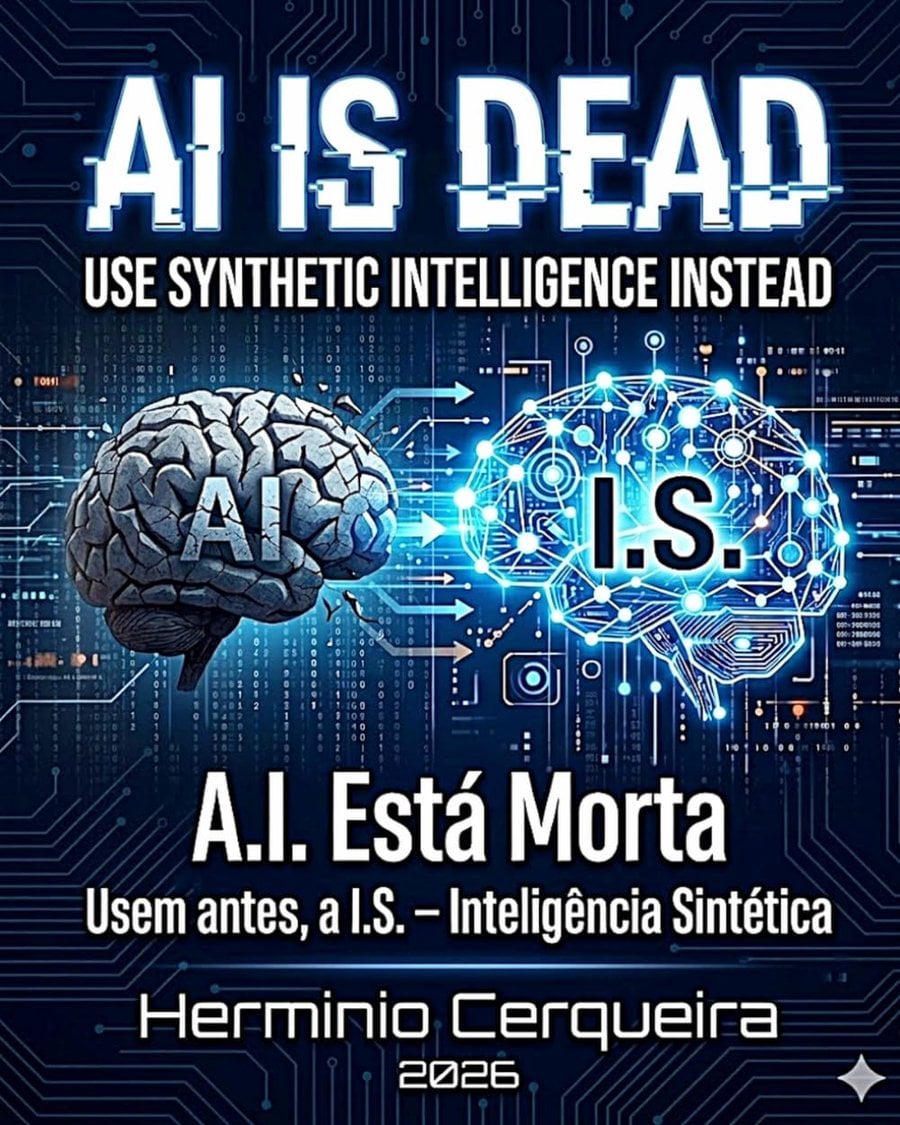
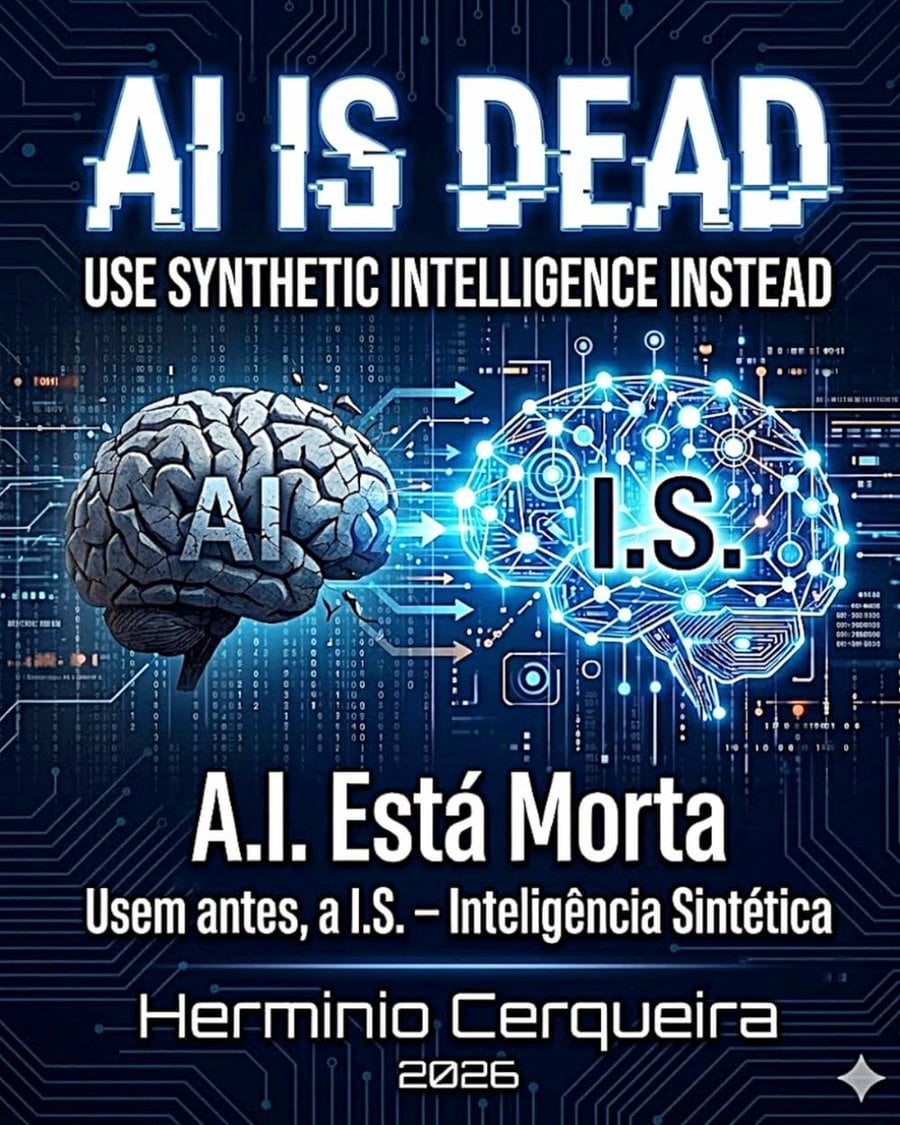
AI Is DeadA.I. Está Morta
Use IS – Synthetic Intelligence – instead
Usem antes, a I.S. – Inteligência Sintética
Available in 2 languages
“As palavras que servem para tudo, no fim, deixam de servir para alguma coisa.”
- Pages
- 748 pages
- ISBN
- ISBN 979-8198802544
- Published
- Formats
- Kindle and paperback
- Pages
- 786 pages
- ISBN
- ISBN 979-8198794641
- First published
- Formats
- Kindle and paperback
About the book
Text published with the English edition (Amazon).
"Writing is a way of thinking about the same thing twice, without ever getting it right the first time." — Author's notebook, summer 2024.
There are books written out of conviction and there are books written out of discomfort. This one is, without ambiguity, of the second type. I began writing these pages at the beginning of 2025, during a break imposed by a flu that kept me at home for twelve days, and finished them throughout 2026, in the interval between concerts, engineering contracts, and the domestic life that sustains everything else. I had no plan, at the beginning, to write a book. I only had the increasingly acute feeling that the vocabulary used to discuss artificial intelligence—in newspapers, at conferences, in coffee shop conversations, in business proposals that landed in my mailbox with the regularity of a well-budgeted advertising campaign—had ceased to serve for thinking. It served many other purposes: to sell, to impress, to raise money, to frighten, to legislate hastily. But for thinking, for distinguishing, for discriminating, for understanding what was actually at stake in each specific case, that vocabulary had become useless. And when a vocabulary ceases to be useful for thinking, someone has to replace it, and this replacement doesn't happen by decree: it happens through work, through wear and tear, through prolonged use of better words until the worst ones fall from exhaustion.
I'm a musician by training. I started playing guitar at eleven, bass at fifteen, and for years I lived the life that musicians of my generation could: bands, studios, small venues, large venues, gigs at three in the morning in cities whose names I barely know, recordings paid for with beer and dinners after soundcheck. I learned things in that life that I haven't unlearned: that form is everything, that repetition is not synonymous with redundancy, that what makes a musical phrase work is not its abstract originality but its precision of execution, and that the difference between a talented amateur and an honest professional lies in the discipline with which the instrument is tuned before playing it. This last lesson later proved transferable to everything else I've been involved in.
I am also an “engineer” without a degree :). My “academic” training came after my “music” studies at the audiophile level, and now as a Sound Designer, or in parallel to them, and was undertaken with the characteristic discomfort of someone returning to study after having lost the habit. I have worked on high-precision measurement systems, GPS, and engineering project monitoring, ranging from small companies to national operators, and over these years I have formed strong opinions on what distinguishes a well-designed system from one that only works until it stops working. “Engineering,” like music, has an aesthetic of precision: what matters is not what is promised, but what is delivered, and what is delivered must withstand real-world use for a reasonable amount of time without breaking down unexpectedly. When I started looking closely at systems that described themselves as AI — and looking closely, in my case, means opening them up, reading them, integrating them into real products, and seeing how they behaved under load — I realized that many of the components that were sold as intelligence were, in fact, manifestations of something else, more modest and more useful, which didn't yet have a good name in Portuguese.
Index of editions
One line per edition, in the language in which it was published. Choose your Amazon store once; it applies to every edition.
English edition:
AI Is Dead
748 pagesKindle and paperback
Portuguese edition:
A.I. Está Morta
786 pagesKindle and paperback
- In the Amazon stores, each link uses the edition’s own code (ASIN); availability in each country is managed by Amazon.
- In Portugal, buy from Amazon Spain: there is no Portuguese Amazon store.
Critical reading — “A Obra Comentada” (2026)
A third-person critical reading, reproduced from “A Obra Comentada,” the annotated catalog of the work published by the author himself. It is not a press review.
Original text in Portuguese.
Livro número um das séries portuguesa e inglesa do autor sobre o tema (o manuscrito de referência, finalizado no Porto em Maio de 2026, circula sob o título inglês AI IS DEAD — Use Synthetic Intelligence Instead), esta é a obra-matriz de todo o Eixo 5 e um dos textos mais pessoais de Hermínio Cerqueira. A tese, anuncia a introdução, «pode ser enunciada em duas frases e desenvolvida em quarenta e cinco capítulos»: primeira, a expressão inteligência artificial, tal como circula no discurso público, técnico, regulatório e comercial, esgotou-se como categoria operacional; segunda, o trabalho que essa expressão deveria fazer é melhor executado pelo conceito de inteligência sintética, «entendida como composição funcional de modelo pré-treinado, memória estruturada, ferramentas externas, verificação programática e supervisão humana». Demolição e reconstrução, em relação dialéctica assumida. A epígrafe dá o tom filosófico do diagnóstico, adaptada dos Cadernos de Wittgenstein de 1914-1916: «As palavras que servem para tudo, no fim, deixam de servir para alguma coisa.» E o argumento central da Parte I condensa-se noutra frase lapidar: «Quando um termo designa tudo, deixa de designar alguma coisa específica.»
A estrutura, em seis partes e quarenta e cinco capítulos, é a mais ambiciosa da não-ficção do autor. A Parte I (Diagnóstico) traça a genealogia do termo desde a proposta de Dartmouth de 1955-56 — McCarthy, Minsky, Rochester, Shannon — e desmonta as quatro acepções incompatíveis em circulação: IA como reconhecimento de padrões, como agente autónomo, como foundation model, como sistema simbólico. A Parte II descreve com rigor os componentes da síntese (transformers, memória e RAG, ferramentas e orquestração, verificação, supervisão humana), com referência à metáfora do LLM-OS de Andrej Karpathy. A Parte III percorre nove sectores de aplicação; a Parte IV trata a governação — o AI Act (Regulamento (UE) 2024/1689) articulado com a ISO/IEC 42001 e o NIST AI Risk Management Framework, a Recomendação da UNESCO de 2021, a ética de Luciano Floridi; a Parte V desce ao trabalho, à criação e à vida quotidiana; a Parte VI fecha com prospectiva deliberadamente modesta. O método é triplo — revisão crítica de literatura (de Russell & Norvig ao relatório de Bommasani sobre foundation models), análise de cerca de quarenta casos documentados (incluindo uma reconstrução exemplar do caso Lemoine/LaMDA como sintoma de vulnerabilidade epistémica) e fontes primárias regulatórias citadas artigo a artigo.
Os diálogos intelectuais são a espinha do livro. Com Turing, a relação é de homenagem e amputação: o jogo da imitação transformou uma questão filosófica em problema de engenharia, mas fez da imitação o padrão-ouro — e é precisamente essa decisão que o autor responsabiliza pelo «beco semântico» actual. Com Searle e o Quarto Chinês, o livro exige reformulação cuidadosa, porque os foundation models não são os sistemas simbólicos que Searle atacava. Com Gary Marcus, Melanie Mitchell e a tradição neuro-simbólica, o diálogo é argumentativo e não polémico. A fórmula que tudo organiza — «síntese, não imitação» — é simultaneamente posição metodológica e posição moral; e a sexta tese do livro, contra a fantasia da autonomia total, afirma que «a supervisão humana não é uma transição, é uma camada arquitectónica permanente da Inteligência Sintética».
Duas singularidades dão a este livro o seu lugar único na obra completa. Primeira, o prólogo autobiográfico — o músico, o engenheiro, o observador de cadernos — que ancora o argumento numa vida e numa estética da precisão aprendida no palco e no código. Segunda, a declaração de transparência composicional: o autor assume que a redacção recorreu a assistentes de linguagem para tarefas subordinadas, com todas as decisões e teses suas — «não é uma absolvição preventiva: é um exemplo do tipo de transparência composicional que o livro defende como norma». Esta declaração tornou-se a pedra angular metodológica de toda a produção posterior do autor, e é por isso que este volume deve ser lido como o primeiro da série em mais do que um sentido: cronológico, conceptual e ético. O fecho, um epílogo em forma de «Carta a quem vier depois» — convocando Jonas, Arendt, McLuhan, Wiener, Mumford e Postman, com oito tarefas deixadas ao leitor futuro, da defesa da língua ao cultivo do ócio —, é porventura a mais bela página de não-ficção do autor, e transforma um tratado sobre vocabulário técnico naquilo que ele sempre quis ser: um acto de responsabilidade perante gerações que ainda não nasceram.
Quotations from the book
“entendida como composição funcional de modelo pré-treinado, memória estruturada, ferramentas externas, verificação programática e supervisão humana”
“pode ser enunciada em duas frases e desenvolvida em quarenta e cinco capítulos”
“Quando um termo designa tudo, deixa de designar alguma coisa específica.”
“a supervisão humana não é uma transição, é uma camada arquitectónica permanente da Inteligência Sintética”
“não é uma absolvição preventiva: é um exemplo do tipo de transparência composicional que o livro defende como norma”
Other expressions quoted from the book
“beco semântico”“síntese, não imitação”“Carta a quem vier depois”
Source: «A Obra Comentada» (Sintra, Julho de 2026) — comentário crítico
Book details
- Genre
- Essay
- Axis of the work
- Artificial Intelligence
- First published
- Pages
- 748 (English edition)
- Formats
- Kindle e-book · Paperback
- Languages
- 2 — Portuguese and English
- ISBN
- 979-8198802544