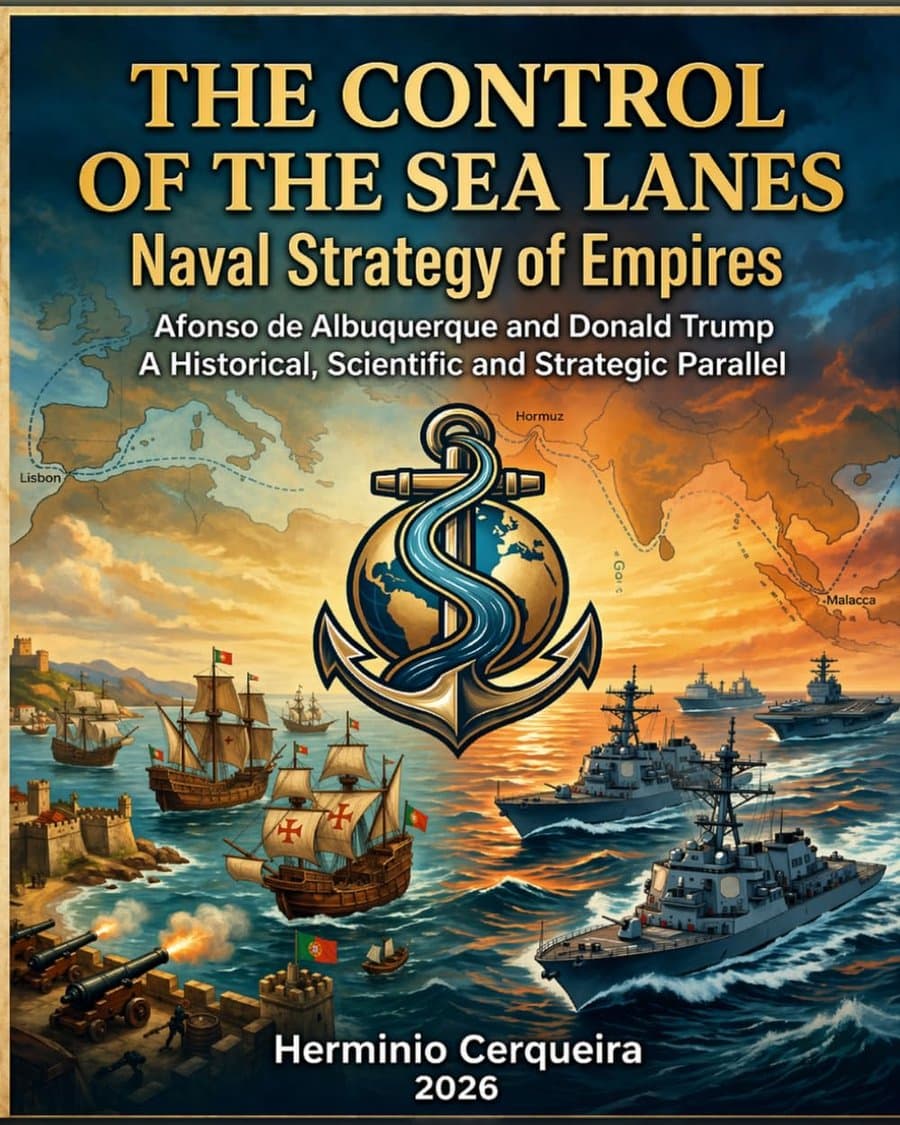
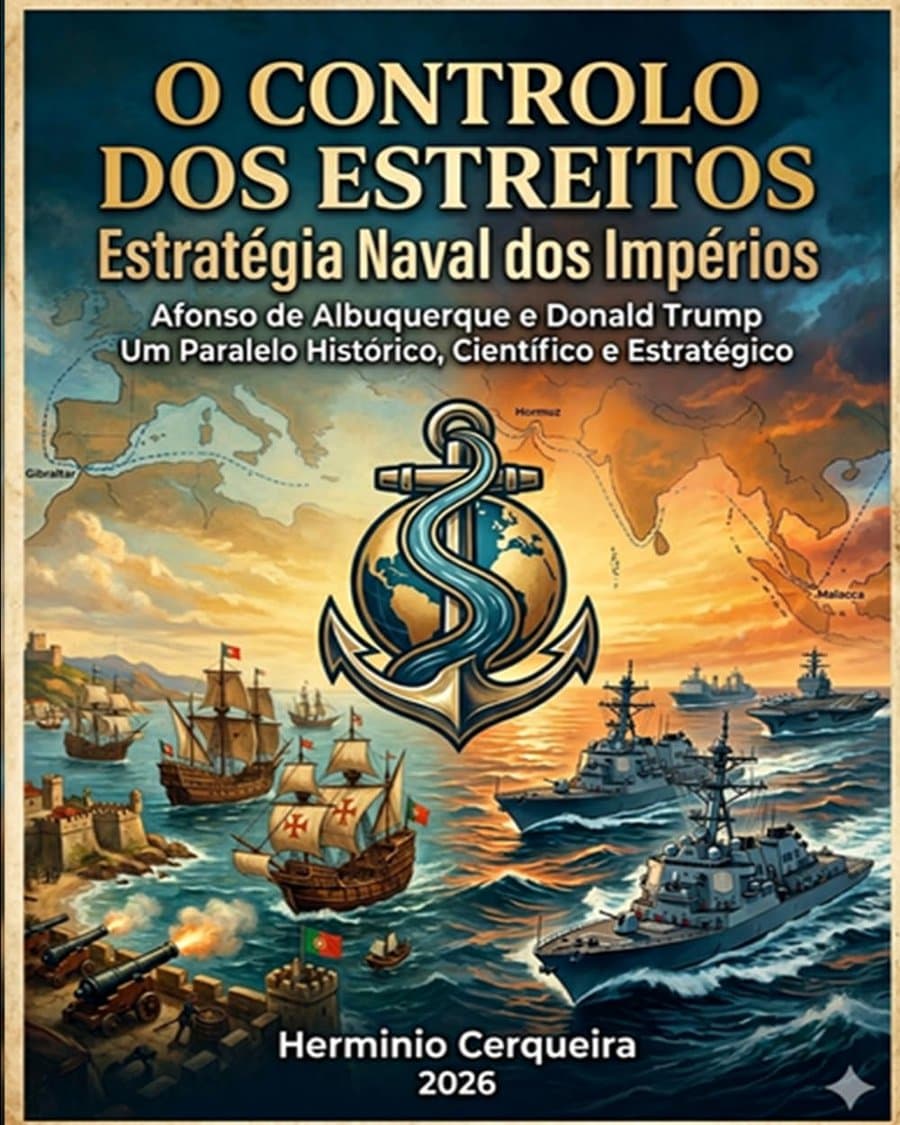
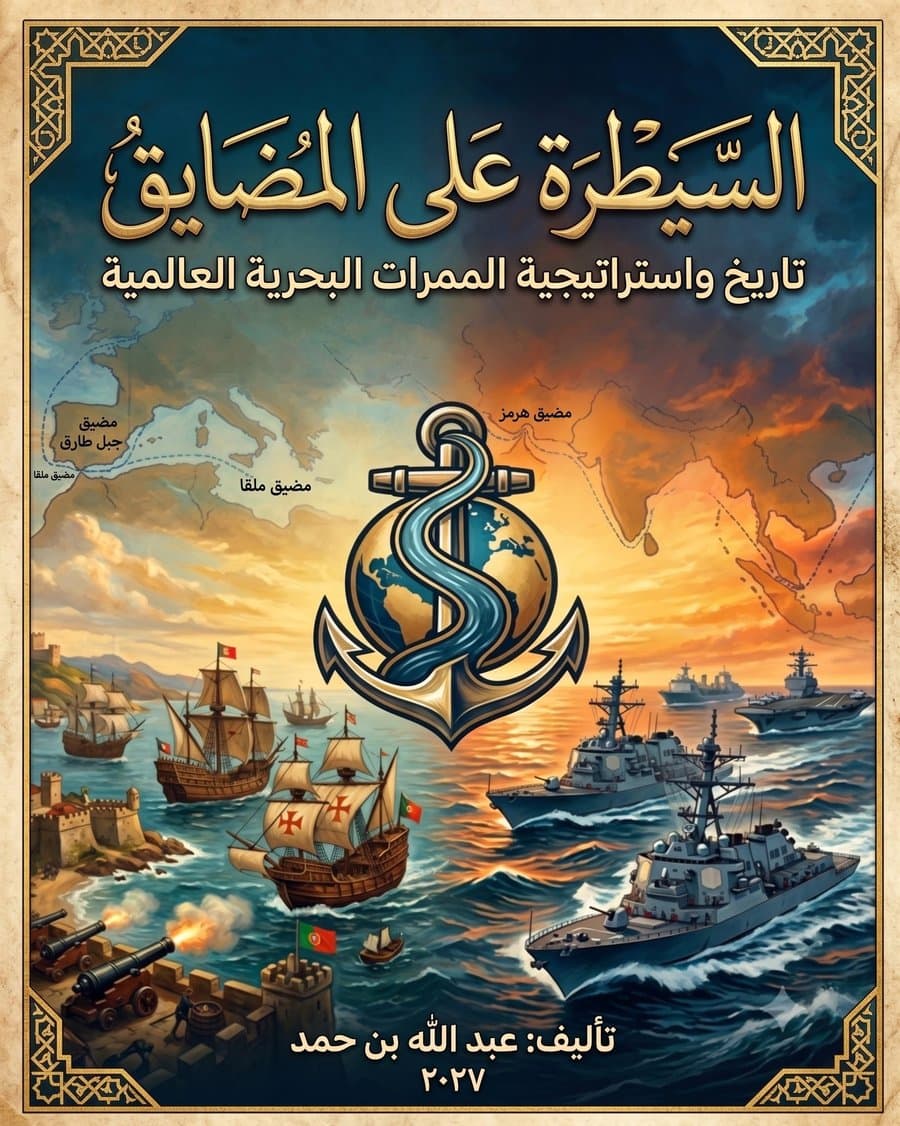
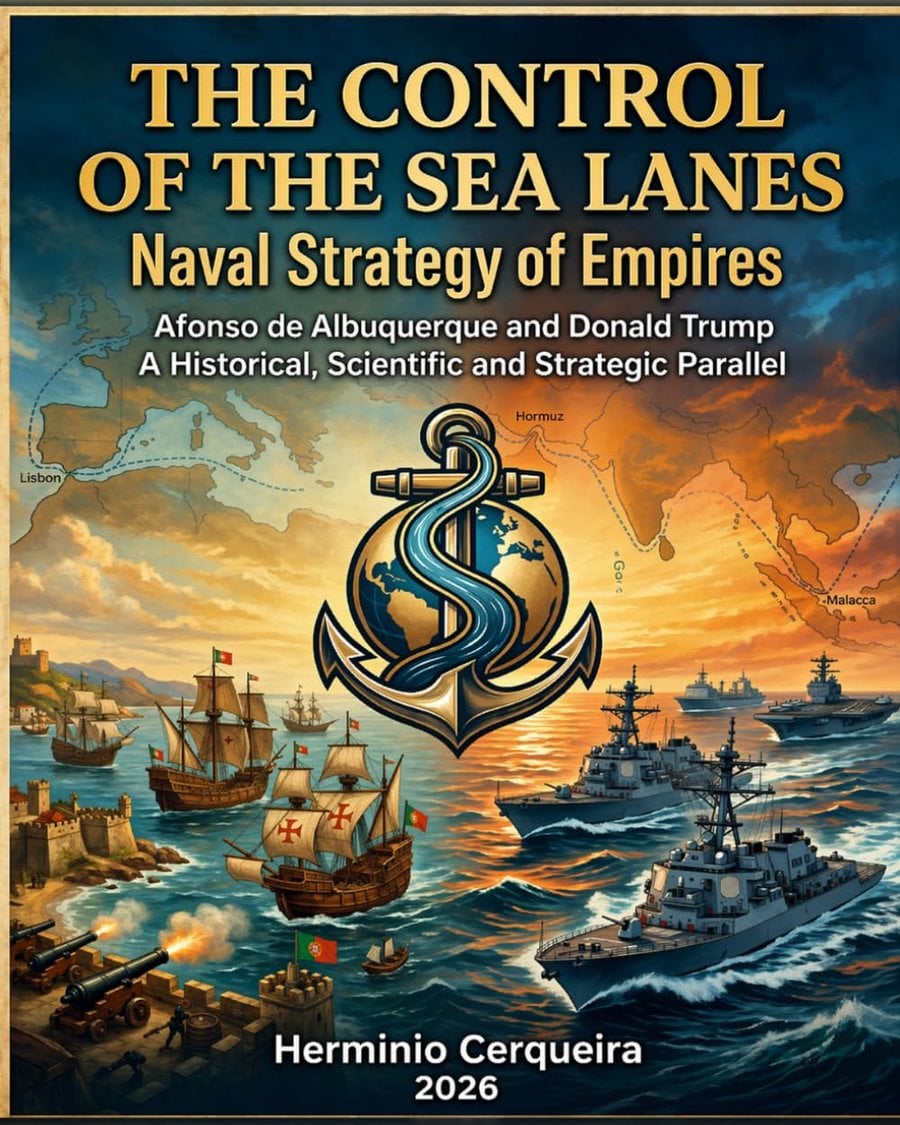
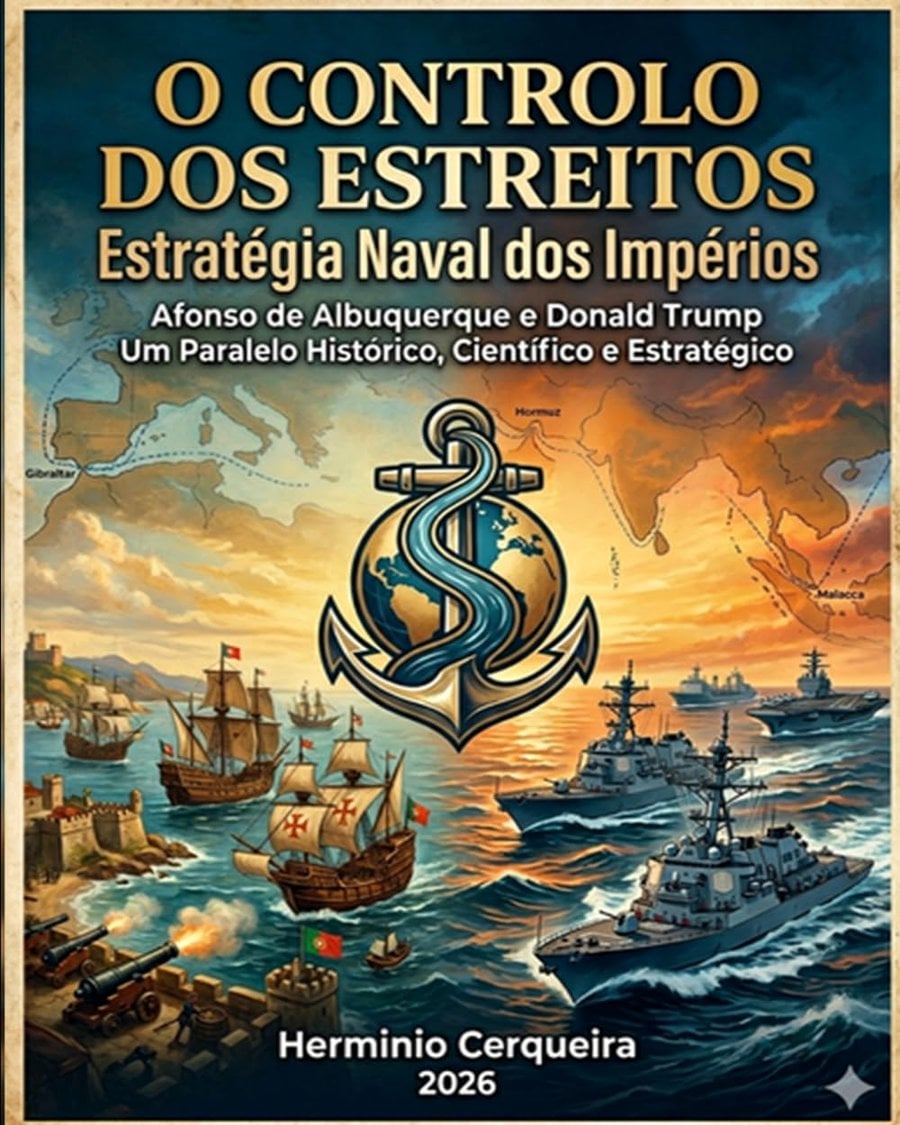
Control of the StraitsO Controlo dos Estreitosالسيطرة على المضائق
Naval Strategy of Empires
Estratégia Naval dos Impérios
الاستراتيجية البحرية للإمبراطوريات
Available in 3 languages
“O oceano não é um vazio”
- Pages
- 679 pages
- ISBN
- ISBN 979-8199401647
- Published
- Formats
- Kindle and paperback
- Pages
- 713 pages
- ISBN
- ISBN 979-8199394611
- First published
- Formats
- Kindle and paperback
- Pages
- 1,120 pages
- Published
- Formats
- Kindle
About the book
Text published with the English edition (Amazon).
In memory of Afonso de Albuquerque, Lion of the Seas, who demonstrated that strategic intelligence surpasses brute force, and that control of the sea is control of the world.
And to all those who navigate impossible straits with insufficient resources and unlimited vision.
- Hermínio Cerqueira
The Sea as an Instrument of Global Power
1.1 The geometry of sea power
The ocean is not a void. On the contrary, it is the oldest and most persistent axis of power that humanity has built, a three-dimensional space where trade routes, energy supply lines, industrial logistics chains, and vectors of military projection intersect. Understanding maritime power requires, first and foremost, recognizing its specific geometry: unlike land power, which is exercised in contiguity and knows borders, friction, and physical barriers, power over the sea tends towards ubiquity—whoever dominates it can, in theory, appear at any point on the ocean's surface, with concentrated force and unrestricted mobility. This fundamental asymmetry between land dominance and maritime dominance is the basis of all strategic theory that has developed from the 16th century to the present.
The geometry of maritime power is organized around three analytical categories that interpenetrate without ever becoming confused: access, control, and denial. Access refers to the ability to freely use the sea—for commercial purposes, for projecting force, or for strategic surveillance. Control implies the ability to regulate the use of the sea by third parties, distinguishing between allies who are granted passage and adversaries who are denied it. Denial, in turn, refers to the ability to prevent an adversary from using the sea, even without the need for absolute control—it is enough that the imposed cost is high enough to change the adversary's behavior. The 2026 Hormuz crisis is, in essence, a combined exercise of selective control and denial: Iran did not close the strait to all navigators, but instituted a discriminatory regime that distinguished between "hostile" and "friendly" nations, imposing tolls in yuan on some and granting free passage to others (CSIS, 2026).
The geometry of maritime power is also organized vertically in historical time. Empires that understood the sea as an instrument of power—Athens, Carthage, Venice, Portugal, the Netherlands, Great Britain, the United States—shared a structural characteristic: the ability to convert naval mobility into commercial wealth and, conversely, commercial wealth into sustained naval capacity. Paul Kennedy called this cycle of mutual reinforcement the "material foundation of imperial power" (Kennedy, 1987), and its absence is often the prelude to decline. Fourteenth- and fifteenth-century China exemplifies the other side: Zheng He led seven major expeditions to the Indian Ocean and the east coast of Africa between 1405 and 1433, but the Ming state chose to withdraw from the sea and destroy fleet records, spontaneously surrendering the maritime advantage to the Europeans who would arrive there a few decades later.
Maritime power is neither static nor automatic. It depends on maintaining a set of conditions that Alfred Thayer Mahan first systematized with scientific rigor in 1890, and which subsequent authors have deepened and revisited in light of technological and geopolitical transformations. What is important to emphasize in this analytical overview is that the sea is simultaneously a resource and a vulnerability: a resource for those who dominate it, because it allows global projection at a relatively low cost; a vulnerability for those who depend on its routes without having the means to defend them.
Index of editions
One line per edition, in the language in which it was published. Choose your Amazon store once; it applies to every edition.
On Amazon
English edition:
Control of the Straits
679 pagesKindle and paperback
Portuguese edition:
O Controlo dos Estreitos
713 pagesKindle and paperback
Arabic edition:
السيطرة على المضائق
1,120 pagesKindle
Publisher editions
Sold in the publisher’s own store and, where indicated, in other bookstores — not on Amazon.
English edition:
Control of the StraitsChiado Books edition
383 pages
Portuguese edition:
O Controlo dos EstreitosChiado Books edition
1,101 pagesE-book
- In the Amazon stores, each link uses the edition’s own code (ASIN); availability in each country is managed by Amazon.
- In Portugal, buy from Amazon Spain: there is no Portuguese Amazon store.
- For publisher editions without a confirmed page of their own, the link opens the author’s store at the publisher.
Critical reading — “A Obra Comentada” (2026)
A third-person critical reading, reproduced from “A Obra Comentada,” the annotated catalog of the work published by the author himself. It is not a press review.
Original text in Portuguese.
O Controlo dos Estreitos, na sua segunda edição «integralmente revista e ampliada» — oito partes, vinte e quatro capítulos e seis anexos —, é o livro de história e teoria do poder marítimo do eixo, construído sobre um paralelo deliberadamente provocador que o subtítulo anuncia: Afonso de Albuquerque e Donald Trump, ou como dois impérios, a cinco séculos de distância, enfrentaram o mesmo problema — o controlo dos pontos de estrangulamento do comércio mundial. A dedicatória, «à memória de Afonso de Albuquerque, Leão dos Mares», e a epígrafe da sua carta a D. Manuel I — «Quem é senhor do comércio é senhor da riqueza do mundo, e assim do próprio mundo» — emparelhada com a formulação quase idêntica de Walter Raleigh um século depois, estabelecem desde a primeira página a tese da continuidade estrutural: a geografia do poder marítimo muda de tecnologia, não de gramática.
A abertura teórica é das mais sólidas do eixo: «O oceano não é um vazio», escreve o autor, mas «o mais antigo e mais persistente eixo de poder que a humanidade construiu», organizado em torno de três categorias — acesso, controlo e negação — que estruturam depois toda a análise. O primeiro capítulo é um verdadeiro seminário de teoria naval: Mahan e os seis elementos do poder marítimo (aplicados, num gesto característico, ao caso iraniano), Corbett e o command of the sea, Till e Lambert no século XXI, Paul Kennedy e o ciclo de reforço mútuo entre riqueza comercial e capacidade naval, o seguro marítimo como arma estratégica. Segue-se uma cartografia global do risco — Ormuz, Malaca, Suez, Bab el-Mandeb, Gibraltar, Panamá e os Estreitos Turcos, hierarquizados numa análise tridimensional — e, na Parte II, o capítulo português: o modelo de império marítimo do Estado da Índia, os cartazes e a tributação, Goa, Malaca e Ormuz, com a historiografia de Subrahmanyam e Boxer devidamente convocada e com paralelos explícitos entre a administração albuquerquiana e a crise de 2026. Porque é essa crise — o bloqueio de Ormuz — que funciona como «caso-mestre» de todo o livro: o momento em que a teoria dos chokepoints deixou de ser académica.
No conjunto da obra, O Controlo dos Estreitos é a coluna vertebral histórica do ciclo de Ormuz: fornece a longue durée que O Atlântico em Chamas narra no presente e que a Crise Energética Mundial projecta no futuro. E é também o livro em que o autor mais claramente reivindica um lugar português na teoria estratégica universal — não por patriotismo retrospectivo, mas por um argumento incómodo e bem documentado: o de que o primeiro império a compreender e a praticar sistematicamente o controlo dos estreitos como instrumento de poder global falava português. A segunda edição, muito ampliada, paga o preço habitual da expansão — a densidade de subsecções por vezes fragmenta o fôlego narrativo —, mas ganha em completude o que perde em leveza: é, no seu domínio e no seu idioma, uma obra de referência.
Quotations from the book
“à memória de Afonso de Albuquerque, Leão dos Mares”
“o mais antigo e mais persistente eixo de poder que a humanidade construiu”
Other expressions quoted from the book
“integralmente revista e ampliada”“caso-mestre”
Source: «A Obra Comentada» (Sintra, Julho de 2026) — comentário crítico
Book details
- Genre
- Essay
- Axis of the work
- Strategy and Geopolitics
- First published
- Pages
- 679 (English edition)
- Formats
- E-book · Paperback
- Languages
- 3 — Portuguese, English, and Arabic
- ISBN
- 979-8199401647