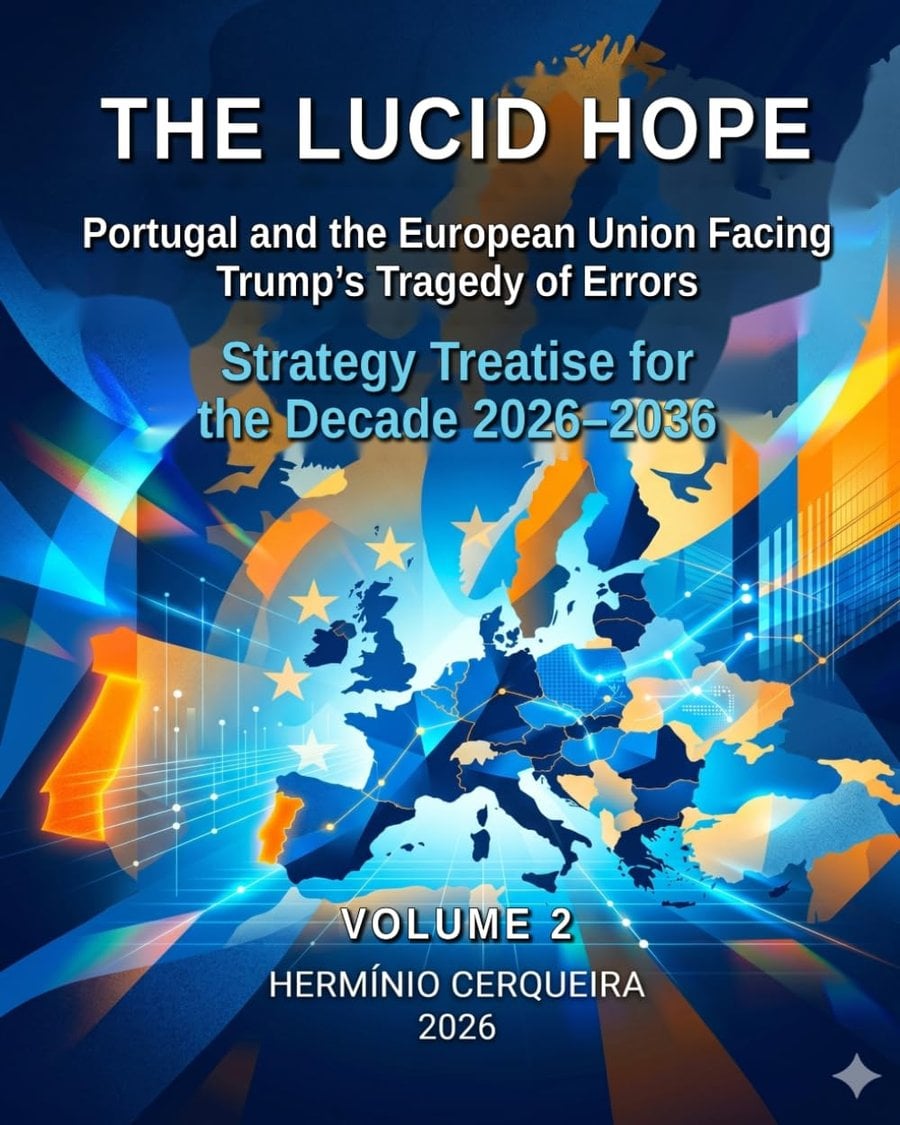
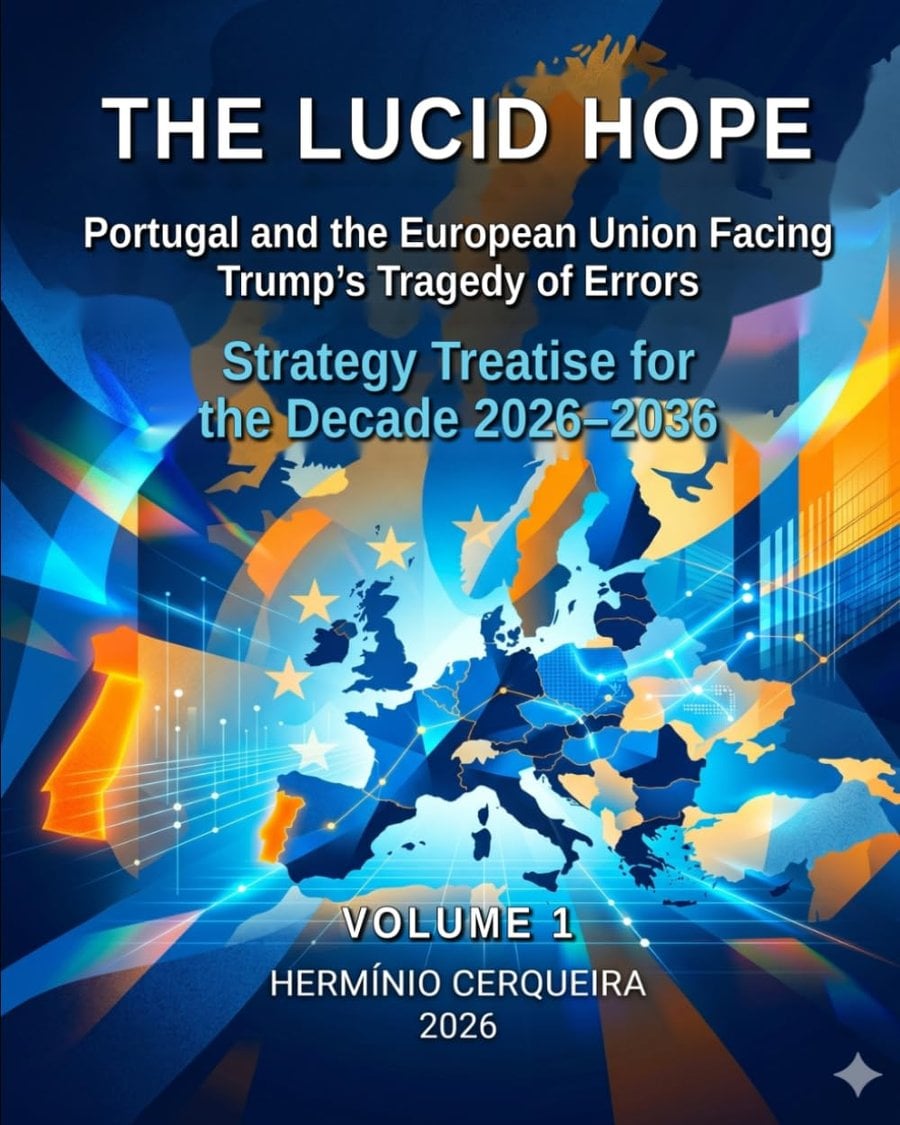
Європа, Португалія та політична економіяЕсеїстикаТом 1
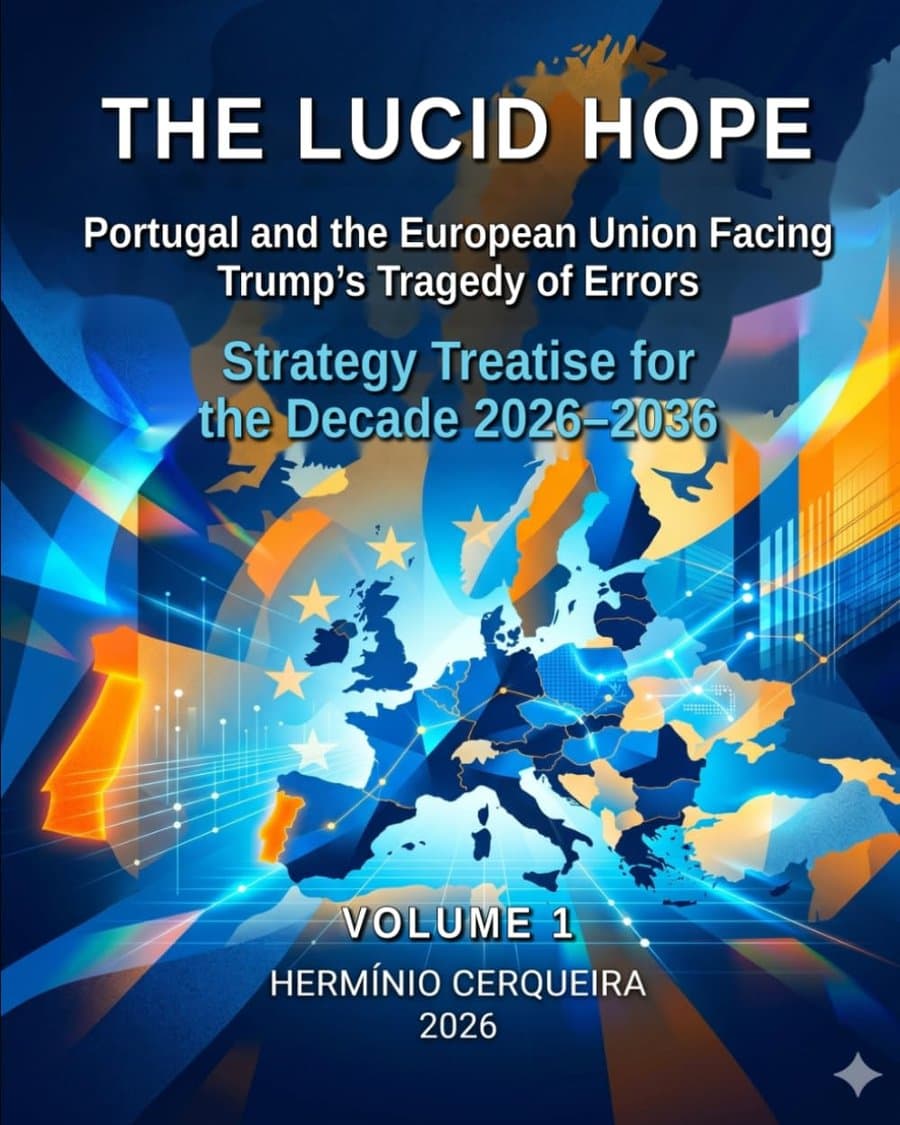
Lucid Hope, Том 1
Portugal and the E.U. in the Face of the Tragedy of Trump's Mistakes
«A esperança não é optimismo. É lucidez activa: a vontade de pensar e de agir como se a história voltasse a ser, em parte, nossa.»
- Сторінок
- 528 сторінок
- ISBN
- ISBN 979-8195318093
- Перша публікація
- Формати
- Kindle і м’яка обкладинка
Про книгу
Анотація з оригінального видання (мова: англійська).
LUCID HOPE
Portugal and the European Union
in the Face of the Tragedy of Trump's Mistakes
Treaty on Political, Economic, Financial,
Trade, Social, and Military Strategy Treaty for the Decade 2026–2036
In memory of those who, throughout all generations,
refused to accept fate as law.
To the young Portuguese who will inherit
the country that their elders will leave them.
To Europe, weary of ancient wars
and always capable of starting over.
“When empires go into decline, the first thing they lose is not territory—it is the internal coherence of their decisions. The peripheries begin to feel the turmoil long before the decline becomes visible in the center.” — Author's note, on the sidelines of the U.S. elections in November 2024.
This first Part begins at the very beginning: at the point where, in the two-year period 2025–2026, three simultaneous shifts that shape the present-day landscape converge. The first is institutional: the erosion of the checks and balances that have disciplined the American presidency for seventy years. The second is kinetic: the return of war between states, on an expeditionary scale, as an instrument of foreign policy, exemplified by the campaign against Iran. The third is cognitive: the realization, by both allies and adversaries, that the United States has ceased to be a reliable provider of global public goods, instead transforming, in successive phases, into a demanding stakeholder in each bilateral relationship.
The following five chapters elaborate on this diagnosis in increasing depth. The first chapter examines the internal dismantling of the American institutional architecture and its transformation into a form of presidential decision-making that is unprecedented since the late 19th century. The second chapter analyzes the Iran war as a geostrategic turning point and as an economic shock transmitted through energy, food, and logistics channels. The third chapter delves into the tariff war that began in 2025 as a tool for redefining the global economic geography. The fourth chapter engages with Stiglitz's essay and puts forward a systemic interpretation that links institutional collapse, kinetic shock, global stagflation, and the end of the liberal order. Finally, the fifth chapter examines the European monetary trap in which the European Central Bank finds itself, with a single mandate and an institutional architecture that limit its ability to respond to supply-side shocks combined with high levels of public debt.
Throughout these pages, readers will recognize echoes of the literature on hegemonic transition—from Charles Kindleberger to Robert Gilpin, from Giovanni Arrighi to Adam Tooze. However, the intended originality lies not in the conceptual framework, but in the courage to apply it, without qualification, to the present day. In this sense, diagnosing is the first political act: because one can only make good decisions about what one has understood well.
Покажчик видань
По одному рядку на кожне видання — мовою, якою його опубліковано. Оберіть крамницю Amazon один раз — вибір діятиме для всіх видань.
На Amazon
Мова видання: англійська:
Lucid Hope
528 сторінокKindle і м’яка обкладинка
Видання видавництв
Продаються в крамниці самого видавництва та, де зазначено, в інших книгарнях — не на Amazon.
Мова видання: англійська:
Lucid HopeВидання Chiado Books
Електронна книга
- У крамницях Amazon кожне посилання використовує код самого видання (ASIN); наявність у кожній країні визначає Amazon.
Критичне прочитання — «A Obra Comentada» (2026)
Критичне прочитання від третьої особи, відтворене з «A Obra Comentada» — коментованого каталогу творчості, виданого самим автором. Це не рецензія в пресі.
Оригінальний текст португальською.
Publicado em inglês em dois volumes sob o título Lucid Hope e em português num único e monumental tomo — A Esperança Lúcida, edição definitiva de Abril de 2026, com 25 partes, 150 capítulos, 8 anexos e 886 páginas —, este é o tratado do catálogo: um «Tratado de Estratégia Político-Económica, Financeira, Comercial, Social e Militar para a Década 2026–2036», apoiado numa compilação de 2.547 fontes documentadas. O título presta tributo expresso a Joseph Stiglitz, que cunhou a fórmula da «tragédia de erros» para a sequência desencadeada pelo regresso de Trump ao poder: a guerra de tarifas universal, a guerra cinética contra o Irão, o bloqueio do Estreito de Ormuz, o abandono da garantia americana à Europa — hybris no sentido aristotélico, não maldade pura, mas excesso de confiança do poder que ignora as consequências sistémicas dos seus actos.
A tese central está no próprio título e é formulada como décima tese da sinopse executiva: «A esperança não é optimismo. É lucidez activa: a vontade de pensar e de agir como se a história voltasse a ser, em parte, nossa.» Entre o catastrofismo e a ingenuidade, o tratado argumenta que o duplo choque de 2025-2026 colocou Portugal e a União perante uma bifurcação histórica — aprofundar a integração e construir autonomia estratégica real, ou fragmentar-se perante a nova desordem global — e que Portugal, pela sua geografia atlântica, infra-estrutura energética emergente e capital lusófono, está objectivamente melhor posicionado do que a maioria dos Estados-membros para ser protagonista, e não apenas receptor, da nova ordem europeia.
A estrutura é a de um verdadeiro tratado clássico: diagnóstico do colapso da Pax Americana (com uma notável leitura schmittiana do decisionismo presidencial americano, temperada pelo reconhecimento explícito dos limites morais de Schmitt), economia política da desordem global (o nexo gás-fertilizantes-alimentos transmitido pelo choque de Ormuz), a União em encruzilhada (legado Draghi, eurobonds, NATO 3.0), anatomia dos parceiros europeus, Portugal em profundidade (Sines «como projecto civilizacional», Açores, hidrogénio verde, CPLP), modelos políticos comparados e, por fim, o Plano Estratégico Decenal 2026–2036, com cenários quantificados — «Renascimento Atlântico», «Declínio Gerido» (a que atribui 55% de probabilidade) e «Ruptura e Recessão». Cada parte abre com uma vinheta ensaística e fecha com proposições accionáveis; a advertência metodológica assume três registos simultâneos — analítico-académico, propositivo-estratégico e ensaístico-literário — porque «as estratégias que não conseguem ser narradas não conseguem ser seguidas».
O diálogo intelectual é vastíssimo: Madison e Schmitt sobre os contrapesos e a excepção, Weber e o «cesarismo plebiscitário», Hassner e a aliança sem ilusões, Aron («a estratégia é o pensamento posto em acção»), Kindleberger, Gilpin, Arrighi e Tooze na literatura da transição hegemónica, Monnet e Draghi nas epígrafes. Mas o tratado termina em registo epistolar e quase lírico: duas cartas — a um jovem cidadão português e a um jovem cidadão europeu — que condensam o programa cívico do livro («Vai, e faz») e recusam tanto o «silêncio cínico» como a «indignação sem trabalho». No conjunto da obra, é a síntese maior do eixo: o livro onde o diagnóstico trumpiano do Eixo 4, a doutrina da autonomia estratégica e a crítica orçamental convergem num único programa para a década. A era que se abre é, escreve o autor, a do «regresso da soberania como verbo. Quem não conjugar este verbo, será conjugado por outros.»
Цитати з книги
«Tratado de Estratégia Político-Económica, Financeira, Comercial, Social e Militar para a Década 2026–2036»
«as estratégias que não conseguem ser narradas não conseguem ser seguidas»
«a estratégia é o pensamento posto em acção»
«regresso da soberania como verbo. Quem não conjugar este verbo, será conjugado por outros.»
Інші процитовані вислови з книги
«tragédia de erros»«como projecto civilizacional»«Renascimento Atlântico»«Declínio Gerido»«Ruptura e Recessão»«cesarismo plebiscitário»«Vai, e faz»«silêncio cínico»«indignação sem trabalho»
Джерело: «A Obra Comentada» (Sintra, Julho de 2026) — comentário crítico
Вихідні дані
- Жанр
- Есеїстика
- Вісь творчості
- Європа, Португалія та політична економія
- Перша публікація
- Сторінок
- 528 (мова видання: англійська)
- Формати
- Електронна книга · Друкована книга (м’яка обкладинка)
- Мови
- 1 — англійська
- ISBN
- 979-8195318093