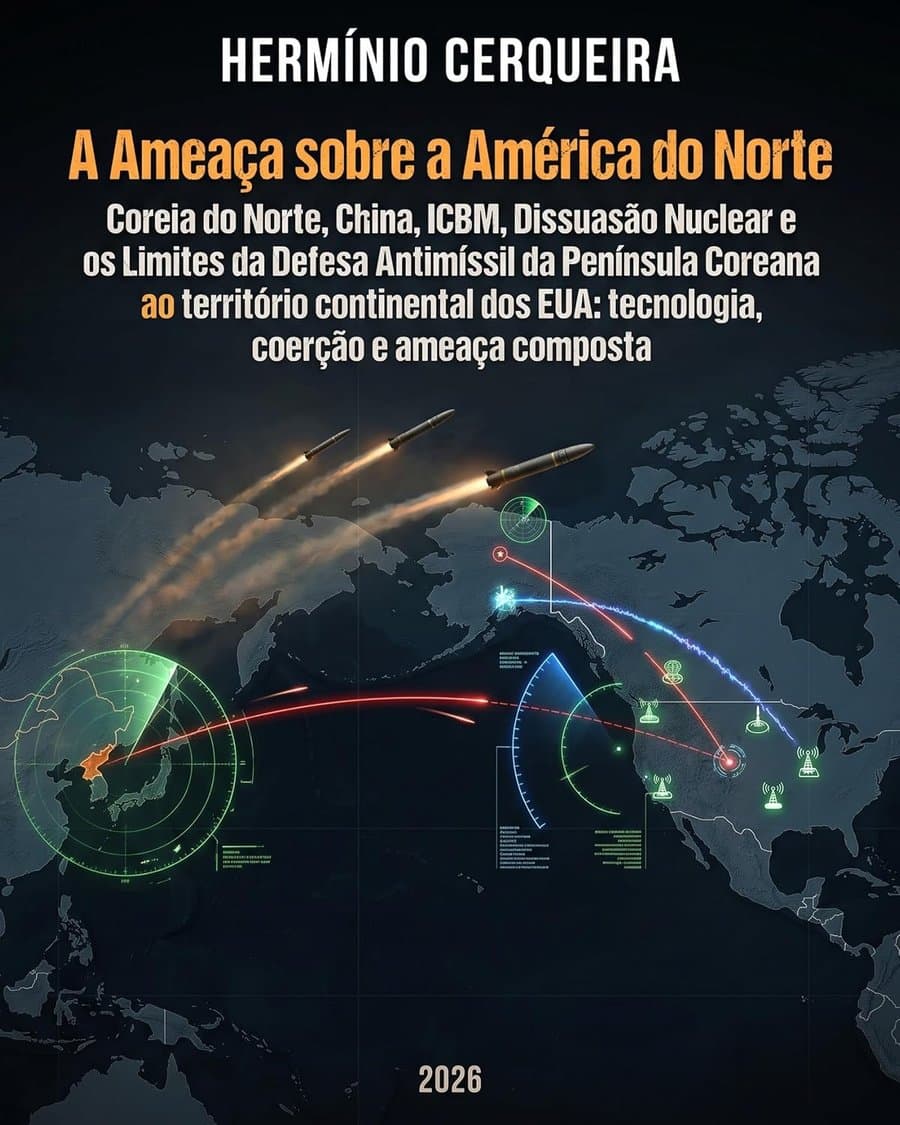
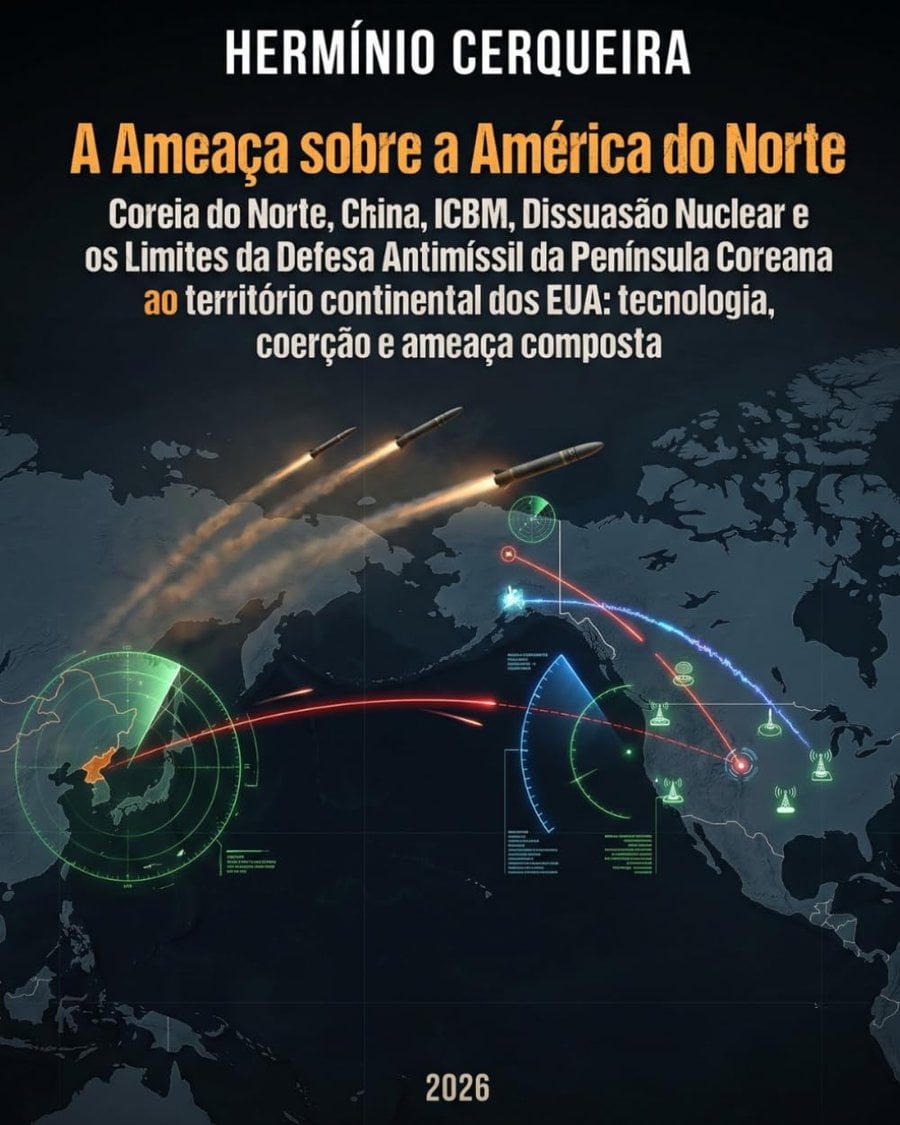
The Threat to North AmericaA Ameaça sobre a América do Norte
North Korea, China, ICBMs, Nuclear Deterrence, and the Limits of Missile Defense
Available in 2 languages
- Published
- Formats
- Kindle and paperback
- Pages
- 694 pages
- ISBN
- ISBN 979-8172511370
- First published
- Formats
- Kindle and paperback
About the book
Text published with the English edition (Amazon).
The new geography of threat
The institutional warning from NORTHCOM, the transition from a regional crisis to a continental defense problem, and the historical genealogy that made nuclear weapons central to the survival of the North Korean regime.
The NORTHCOM warning : "Until now, the main objective of our military apparatus has been to win wars. From now on, its main objective will have to be to avoid them." — Bernard Brodie, The Absolute Weapon: Atomic Power and World Order (1946)
An adverb in the Senate
On February 13, 2025, in a U.S. Senate hearing room, a four-star Air Force general delivered a written, unclassified document of several dozen pages to the Armed Services Committee. His name was Gregory M. Guillot, who had commanded the U.S. Northern Command and the North American Aerospace Defense Command for a year, and the document was his annual [1]posture statement . Among paragraphs about the Arctic, the border with Mexico, drones, and Russia, there was a sentence about North Korea that the rest of this book will unfold. Kim Jong-un's latest ICBM, the general wrote, the Hwasong-19 first tested in October of the previous year, [2]"probably can deliver a nuclear payload to targets throughout North America." [3]The phrase was repeated, almost word for word, before the Subcommittee on Strategic Forces of the House of Representatives on April 30 of the same year.[4]
The important word is the adverb. "Probably" is not a stylistic hesitation; it's a technical gradation, chosen by a general staff that knows every term in a document delivered to Congress will be read by adversaries, allies, journalists, and one day, historians. In the established language of the American intelligence community, "probably" means that the assessment is based on evidence considered sufficient, but not conclusive, and that the institution that subscribes to it agrees to be confronted with it. A general who wanted to alarm would have written "may"; a general who wanted to reassure would have written "might." Guillot wrote "probably may," and what this chapter proposes is to take this adverb seriously: to understand where it comes from, what it supports, what it leaves open, and why, twelve months later, the same commander returned to Congress with a different formulation.
Because the wording changed. In the written testimonies of March and April 2026—submitted to the House Armed Services Committee on March 17, to the Senate on March 19, and to the House Subcommittee on Strategic Forces on April 15, with essentially identical text [1]—the subject was no longer the Hwasong-19 but the Hwasong-20, the solid-fuel missile unveiled at the October 10, 2025, night parade in Pyongyang. [2]Regarding it, Guillot wrote: “While this new weapon has yet to be proven through flight testing, its size suggests it could deliver a nuclear payload anywhere in the United States, and its serious payload section suggests it could be designed to carry multiple reentry vehicles in an effort to complicate U.S. missile defense.” Although [3]this new weapon has not yet been proven in flight tests, its size suggests that it could deliver a nuclear payload anywhere in the United States, and its blunt payload section suggests that it may have been designed to carry multiple reentry vehicles. Three cautionary verbs in one sentence — "has yet to be proven," "suggests," "may be designed" — and, between them, the expression that the public retains: anywhere in the United States ....
Index of editions
One line per edition, in the language in which it was published. Choose your Amazon store once; it applies to every edition.
English edition:
The Threat to North America
Kindle and paperback
Portuguese edition:
A Ameaça sobre a América do Norte
694 pagesKindle and paperback
- In the Amazon stores, each link uses the edition’s own code (ASIN); availability in each country is managed by Amazon.
- In Portugal, buy from Amazon Spain: there is no Portuguese Amazon store.
Book details
- Genre
- Essay
- Axis of the work
- Strategy and Geopolitics
- First published
- Formats
- Kindle e-book · Paperback
- Languages
- 2 — Portuguese and English