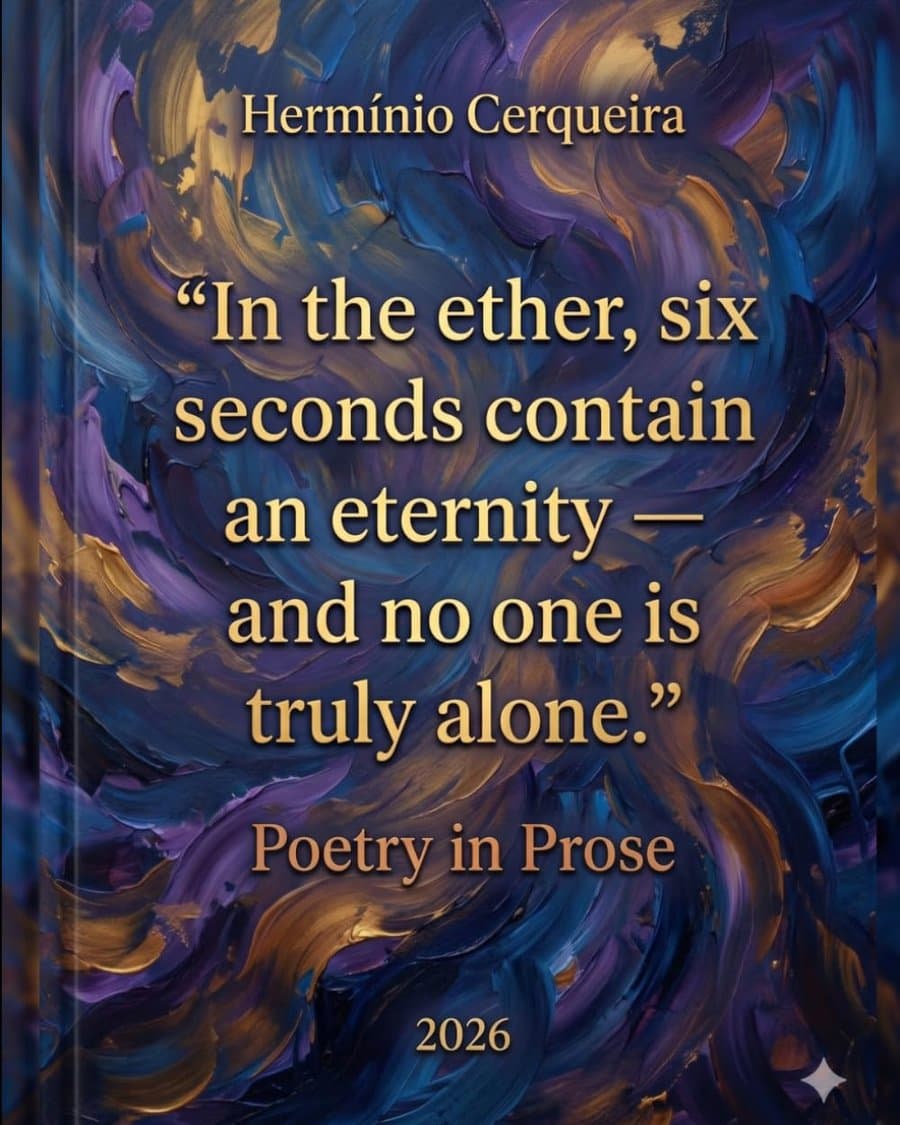
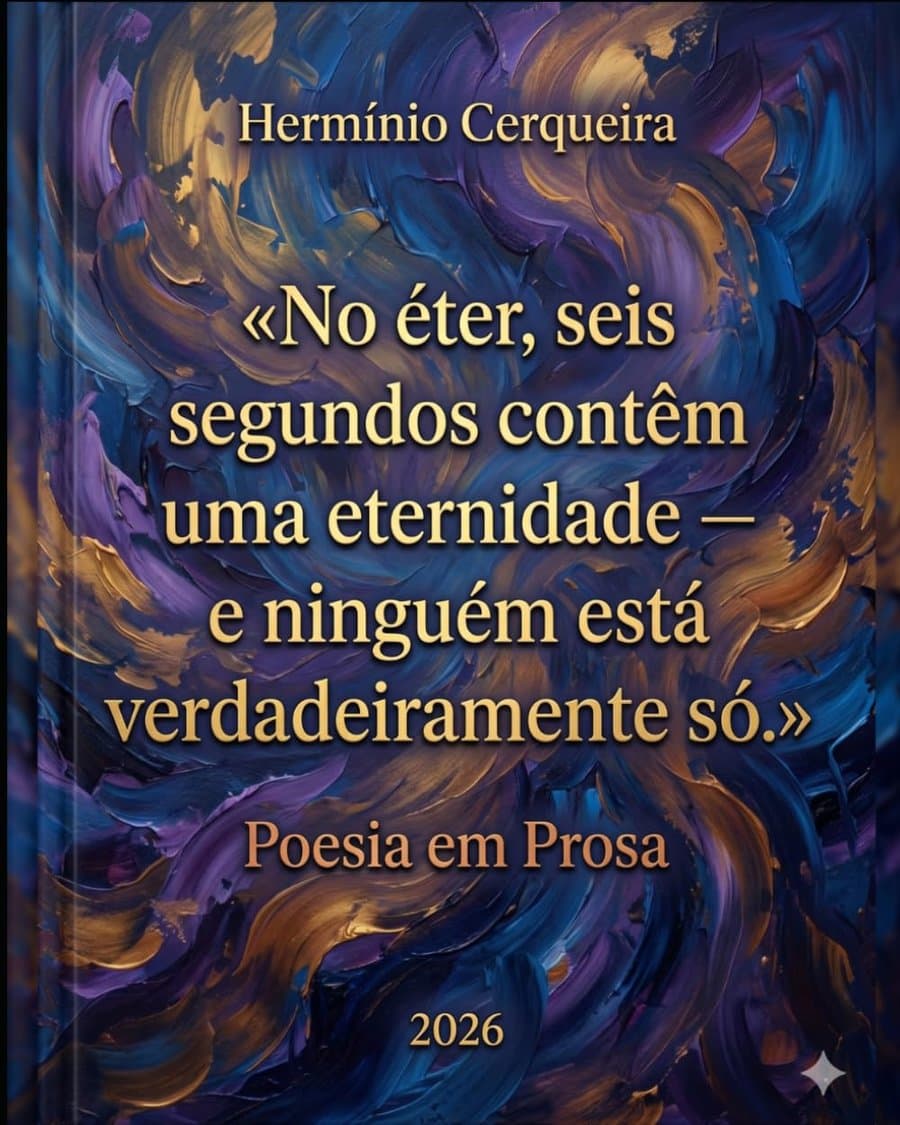
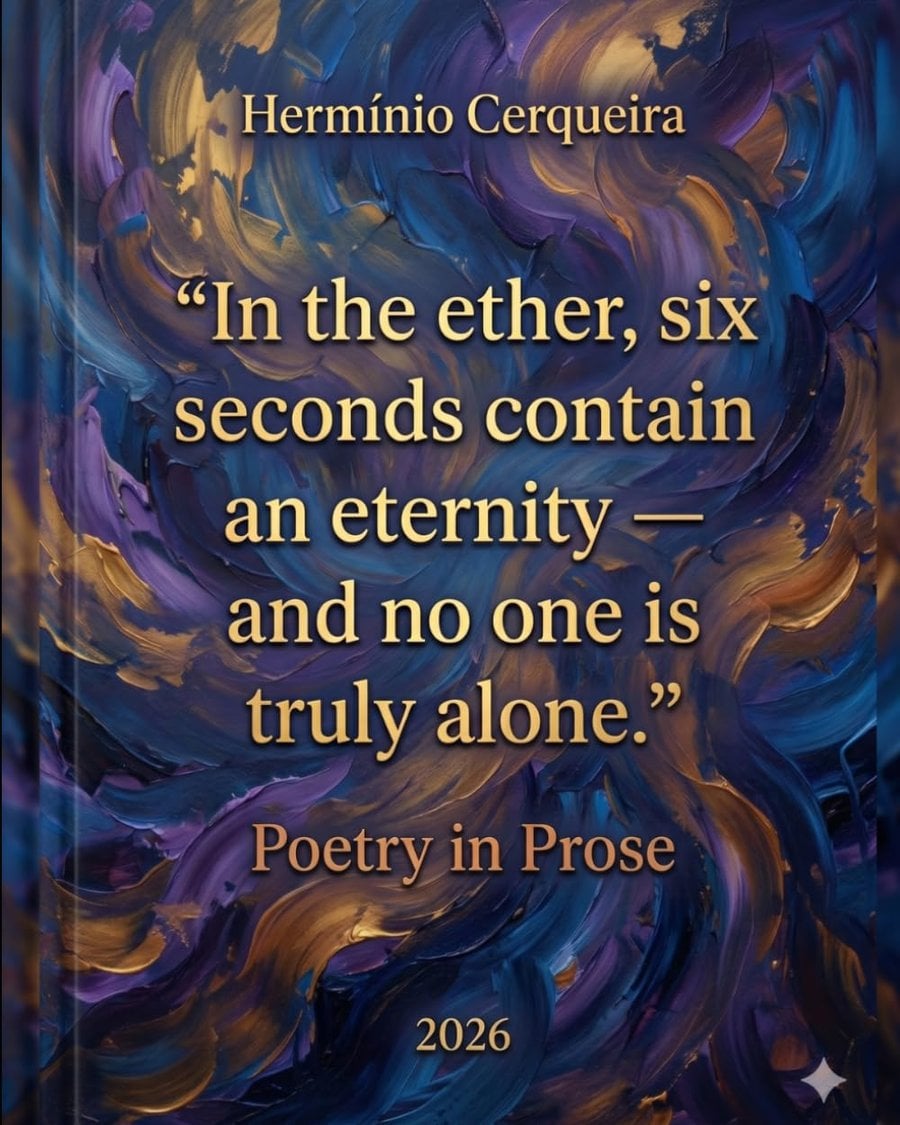
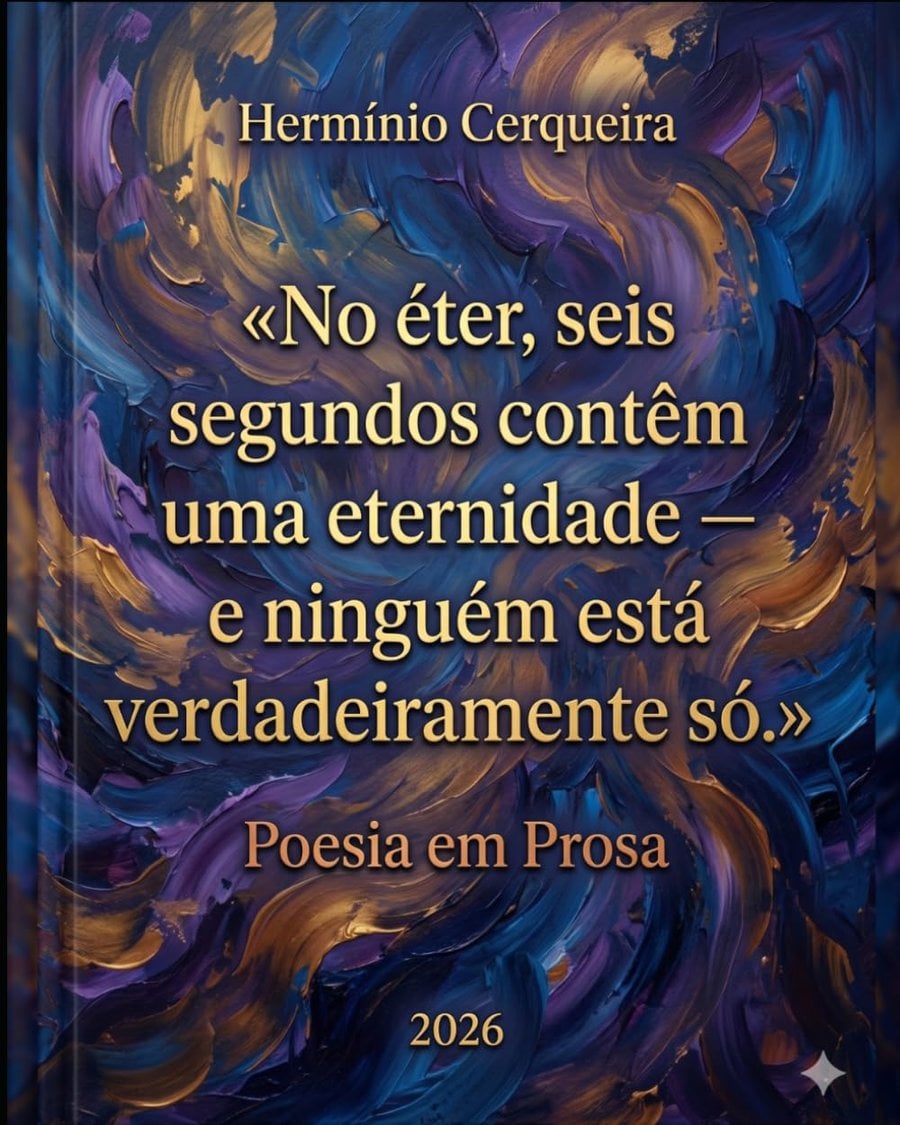
In the Ether, Six Seconds Contain an EternityNo éter, seis segundos contêm uma eternidade
And no one is truly alone
e ninguém está verdadeiramente só
Available in 2 languages
“O corpo fica. E o que parte descobre, atónito, que continua a ser, mesmo sem ele.”
- Pages
- 98 pages
- ISBN
- ISBN 979-8198515758
- Published
- Formats
- Kindle and paperback
- Pages
- 98 pages
- ISBN
- ISBN 979-8198513778
- First published
- Formats
- Kindle and paperback
About the book
Text published with the English edition (Amazon).
Reaching the end of this book is like reaching the summit of a mountain: breathless, yet certain that the exhaustion was worth what one has seen. Those who have read this far will have noticed that these fifty poems do not, in the end, speak of fifty different things. They speak of only one. They speak of man—not of man in the abstract , dissolved in ideas, but of concrete man, made of flesh and gesture, with his two hands, his two arms, his two eyes, his two feet learning to walk. This is the secret geography we traverse: the map of a body that is at the same time the map of a soul.
Because the body, in this book, was never just a body. It was always a symbol of something else. The hands that open or close are the choices we make in relation to others; the arms that lift up or wound are the strength we give to the world and the direction we give it; the eyes that read good or poison are the discernment that saves or loses us; the vigilant walk is the way we traverse existence, attentive or distracted, supporting or stumbling. Man is his own parable. Each limb he possesses is a moral question that life poses to him, and which he answers not with words, but with actions .
That is why the book began with happiness and ended in heaven. Not by chance, and not by a whim of composition. It began with the simplest and most difficult truth of all: that none of us can be entirely happy amidst unhappy people. This phrase, which opens the way, is the seed of everything that followed. From it sprang the meditation on sharing, on the threshold that separates the warm house from the cold street, on the clean shame of those who are content while their neighbor suffers. And from it also sprang, out of inner necessity, the long climb that leads to the end—because if happiness cannot be solely ours, then heaven, which is happiness taken to its highest form, cannot be inhabited in solitude or with disdain.
Between one extreme and the other lies what we might call an ethics of gesture. Not a morality of commandments engraved in stone, but a wisdom learned from one's own body, observing what it asks for and what it refuses. The overflowing vessel teaches us temperance better than any treatise. The cage that kills the bird it wanted to keep teaches us about love more than a thousand declarations. The hand that is merely open to evil to contaminate the one that was open to good teaches us that integrity does not admit halves, that there is no partial virtue, that man is an indivisible unity, and that what he does with a part of himself inevitably affects the whole.
In this collection , there is a conviction that runs through every page like groundwater: that greatness lies not in size, but in direction . A small being can be immense if its soul is worthy; a powerful being can be insignificant if its strength serves harm. What measures a person is not the height they have reached, but how they climbed and what they did when they arrived. That is why the book insists, time and again, on the memory of origin, on the clay of the first steps, on the root that must not be cut. Whoever forgets where they came from loses the ground beneath their feet precisely when they consider themselves highest. And whoever remembers—whoever climbs without denying the smallness from which they started—carries with them, to the summit, the only thing that makes the summit habitable: humility.
Excerpt
«O desígnio maior de todo o homem ao nascer é o de procurar a felicidade, mas nenhum de nós pode ser verdadeiramente feliz enquanto houver, no nosso semelhante, dor que pudéssemos consolar.»
Chega-se ao fim deste livro como se chega ao alto de uma serra: ofegante, e contudo certo de que o cansaço valeu o que se viu. Quem leu até aqui terá reparado que estes cinquenta poemas não falam, afinal, de cinquenta coisas diferentes. Falam de uma só. Falam do homem — não do homem em abstrato, dissolvido em ideias, mas do homem concreto, feito de carne e de gesto, com as suas duas mãos, os seus dois braços, os seus dois olhos, os seus dois pés que aprendem a caminhar.
— No éter, seis segundos contêm uma eternidade
Original text in Portuguese.
Editorial note
Source: publisher’s description of the Portuguese edition (Amazon).
Index of editions
One line per edition, in the language in which it was published. Choose your Amazon store once; it applies to every edition.
English edition:
In the Ether, Six Seconds Contain an Eternity
98 pagesKindle and paperback
Portuguese edition:
No éter, seis segundos contêm uma eternidade
98 pagesKindle and paperback
- In the Amazon stores, each link uses the edition’s own code (ASIN); availability in each country is managed by Amazon.
- In Portugal, buy from Amazon Spain: there is no Portuguese Amazon store.
Critical reading — “A Obra Comentada” (2026)
A third-person critical reading, reproduced from “A Obra Comentada,” the annotated catalog of the work published by the author himself. It is not a press review.
Original text in Portuguese.
Reunião de seis colecções de poesia em prosa — cento e quarenta e um poemas, com posfácio ensaístico para cada colecção —, este volume é a summa do poema em prosa na obra de Cerqueira. As seis partes têm registos deliberadamente distintos: O Caminho do Céu (cinquenta poemas, uma «ética do gesto» sobre a felicidade partilhada), A Criança que Habita (a infância como «subsolo de luz»), O Direito de Pensar (vinte poemas de combate pela liberdade da mente), Alguém que Fica (o abandono infantil e a cura pela presença), O Que Nunca Existiu (uma poética da criação) e Seis Segundos, a colecção-título: vinte poemas em três movimentos — a Travessia, o Espelho, a Presença — sobre uma experiência de quase-morte, «um coração que pára durante seis segundos e, nesse intervalo ínfimo, abre um abismo onde cabe uma vida inteira».
É nesta última colecção que o livro atinge a sua maior tensão metafísica. O primeiro movimento é quase clínico: o corpo que jaz «como uma roupa pousada na cadeira», a língua dos vivos que se torna ruído — «O corpo fica. E o que parte descobre, atónito, que continua a ser, mesmo sem ele.» O segundo movimento tira as consequências filosóficas com imagens de rara precisão: «O tempo não é o rio. O tempo é a estreiteza dos nossos olhos diante do mar»; no «espelho absoluto» do limiar não há juiz, «há apenas o reflexo, e o reflexo basta». O terceiro abre-se, assumidamente, ao sobrenatural — uma presença «vasta e silenciosa, anterior a toda a linguagem» —, mas o posfácio guarda uma honestidade exemplar: não competia ao poeta decidir «se o que os poemas descrevem é revelação ou neuroquímica»; competia-lhe dar-lhe forma.
As restantes colecções gravitam em torno do subtítulo — «ninguém está verdadeiramente só». O Caminho do Céu parte do mote de que nenhum de nós pode ser feliz no meio de infelizes e culmina na imagem mais generosa do livro: «O céu, se existe, é uma varanda» — de onde se acena a quem ainda sobe no escuro. Alguém que Fica condensa a sua tese numa frase que vale um tratado de pedagogia: o que salva uma criança «não é o mundo inteiro a mudar — é uma só pessoa que não vai embora». E O Direito de Pensar liga este eixo ao eixo cívico da obra: a censura como mutilação, a autocensura como censor que «migra de fora para dentro da cabeça», o pedido final «pensa por ti, e escreve». No plano do conjunto, este é o livro em que a meditação sobre a morte, a infância e a criação desagua numa única convicção — a comunhão — que é a face espiritual da tese XVIII: quem viu que ninguém está só não pode reduzir os outros a variáveis de cálculo.
Quotations from the book
“um coração que pára durante seis segundos e, nesse intervalo ínfimo, abre um abismo onde cabe uma vida inteira”
“como uma roupa pousada na cadeira”
“O tempo não é o rio. O tempo é a estreiteza dos nossos olhos diante do mar”
“há apenas o reflexo, e o reflexo basta”
“vasta e silenciosa, anterior a toda a linguagem”
“se o que os poemas descrevem é revelação ou neuroquímica”
“O céu, se existe, é uma varanda”
“não é o mundo inteiro a mudar — é uma só pessoa que não vai embora”
“migra de fora para dentro da cabeça”
Other expressions quoted from the book
“ética do gesto”“subsolo de luz”“espelho absoluto”“ninguém está verdadeiramente só”“pensa por ti, e escreve”
Source: «A Obra Comentada» (Sintra, Julho de 2026) — comentário crítico
Book details
- Genre
- Poetry
- Axis of the work
- Poetry, Spirituality, and Meditation
- First published
- Pages
- 98 (English edition)
- Formats
- Kindle e-book · Paperback
- Languages
- 2 — Portuguese and English
- ISBN
- 979-8198515758